


Culdesac got laughed out of the room; now the room is coming to Culdesac
In 2018, Ryan Johnson, a co-founder of real estate startup OpenDoor, sold his stake in the company and set out to build a car-free neighborhood from scratch in Tempe, Arizona.
At the time, conventional real estate wisdom said this was somewhere between naive and impossible. Phoenix, after all, is the most car-dependent major metro in the United States. More than 92% of households in the region own a car (compared with 45% in New York City). The city is ringed by highways, and its street grid is built almost entirely around the assumption that every trip begins and ends in a parking lot.
Nevertheless, John founded a company, Culdesac, and proceeded to build the car-free neighborhood in Tempe.
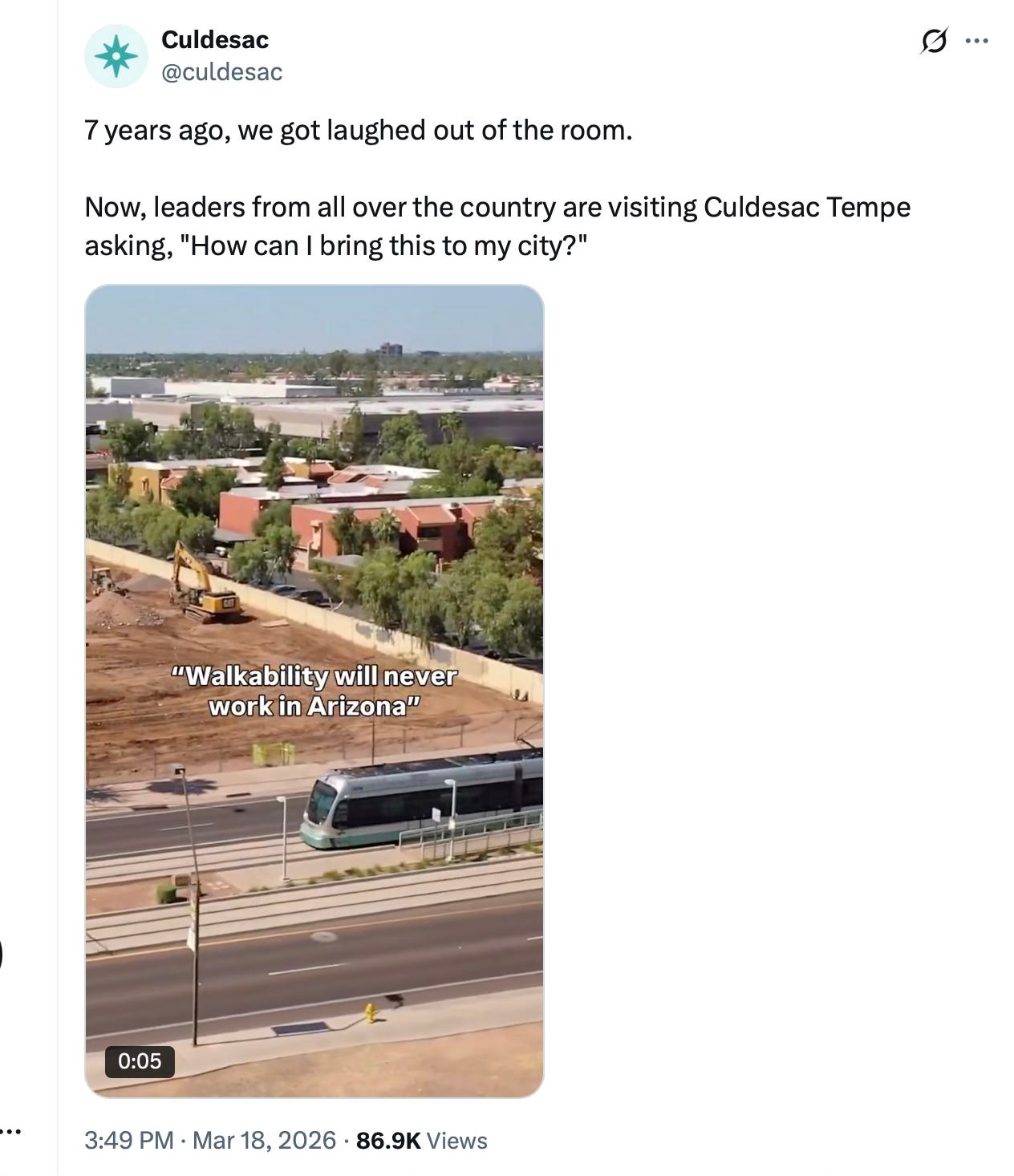
This week, Culdesac posted a two-sentence update on X: “7 years ago, we got laughed out of the room. Now, leaders from all over the country are visiting Culdesac Tempe asking, ‘How can I bring this to my city?’”
This is a case study in what it takes to build something genuinely new in American real estate and what it means for the future of walkable, car-free neighborhoods in the United States.
What Culdesac Tempe Is
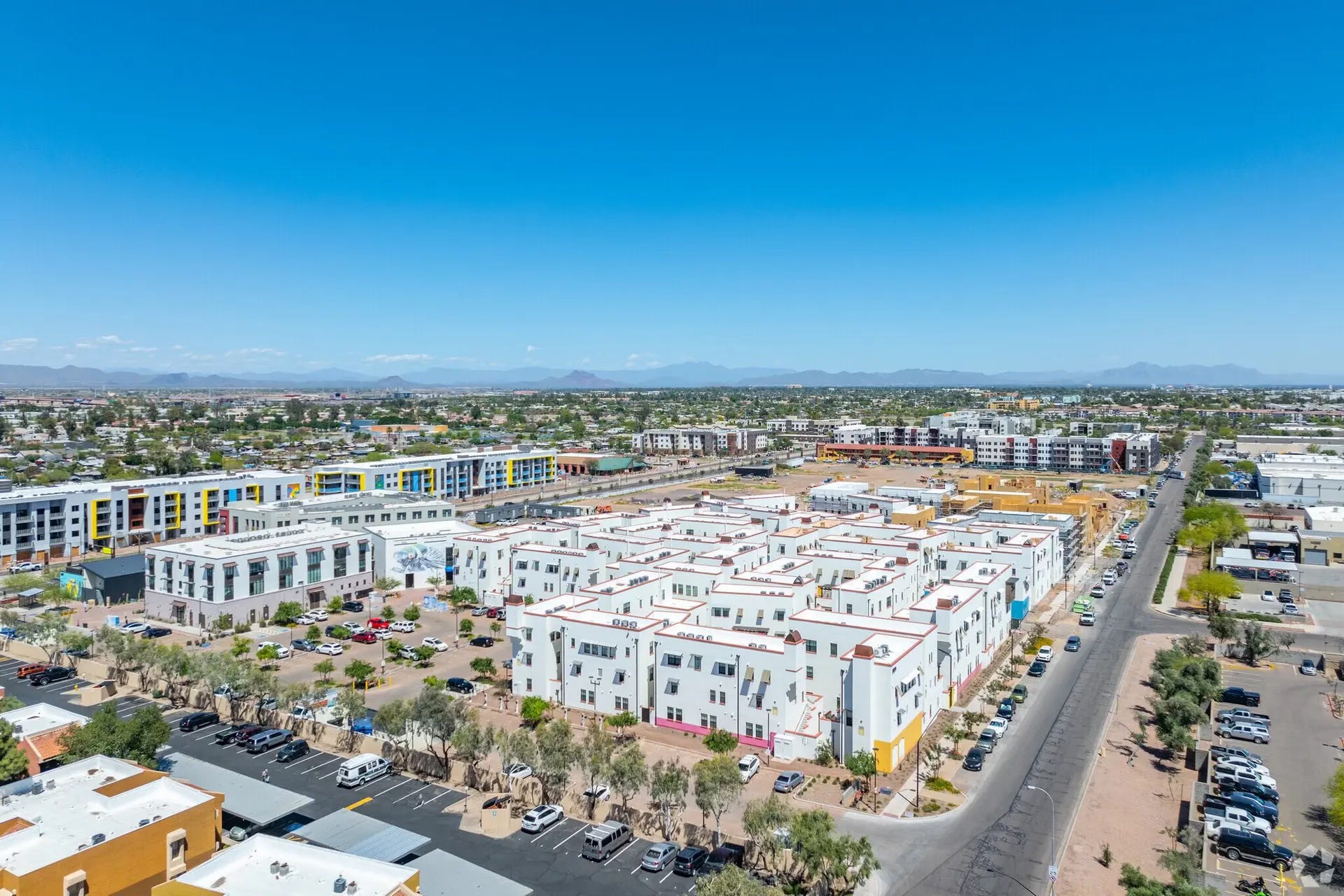
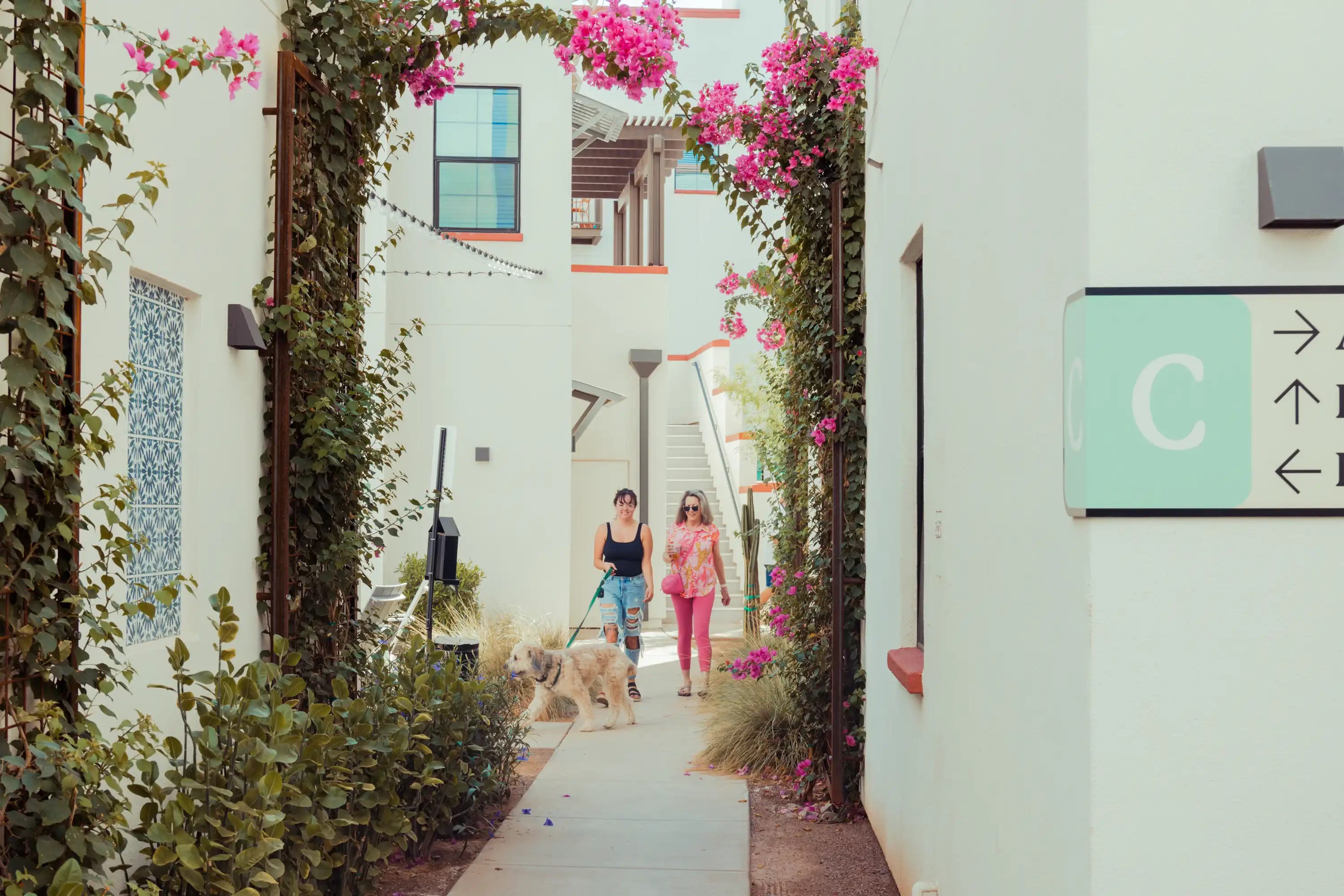
Designed by Opticos Design, Culdesac Tempe sits on 17 acres along Apache Boulevard in Tempe, a suburb roughly 15 miles east of downtown Phoenix. It is built next to a Valley Metro light rail stop.
When all phases are complete (projected for 2028), it will contain:
760 apartments
Pedestrian paseos
A central plaza
And around 21 local businesses housed in clusters of two- and three-story white stucco buildings arranged around shared courtyards
There is no residential parking. None. Cars are not banned outright, but residents agree not to park near the development as a condition of their lease.
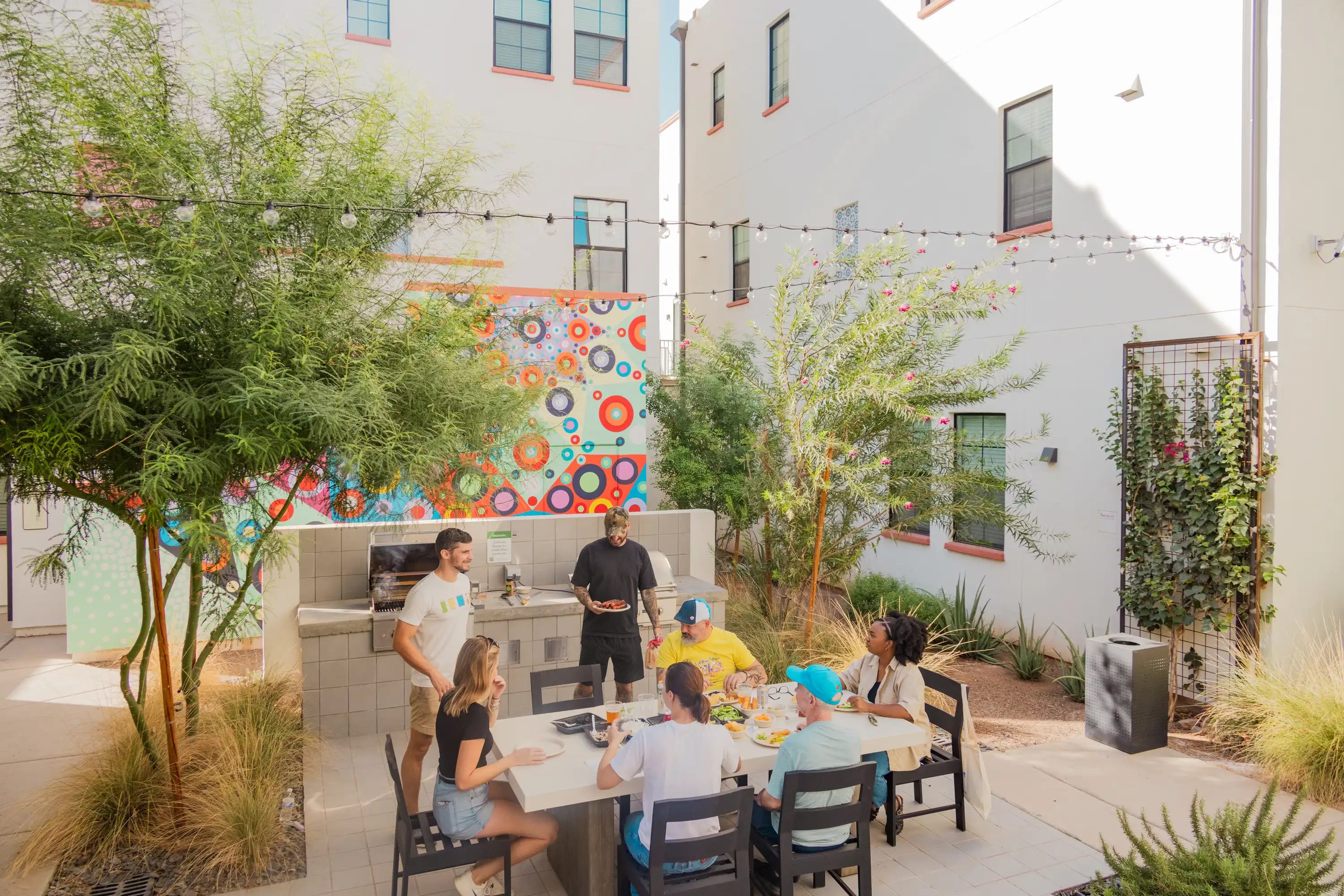
The land that would otherwise be given over to parking lots and driveways is instead shared green space:
Courtyards with fire pits and hammocks
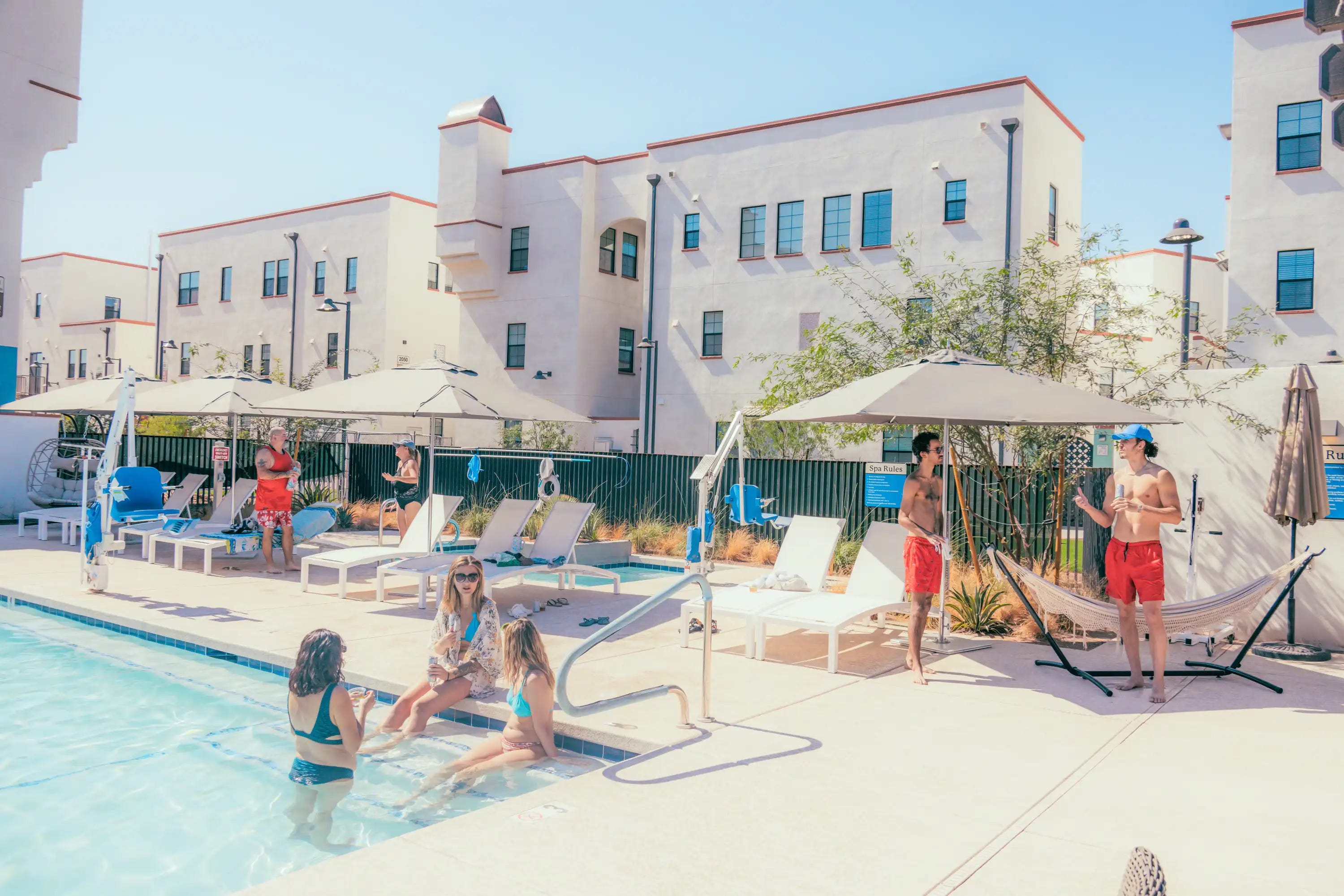
A pool
A bike path
And a community garden
Residents get a free Valley Metro pass, discounts on rideshare and autonomous vehicle services like Waymo, on-site carsharing, Bird scooters, and over 1,000 bike parking spots throughout the neighborhood. The first 200 residents received a free Lectric e-bike.
Construction began in 2019, and the first residents moved in during mid-2023. .
As of March 2025, almost 90% of the completed 288 units were leased.
Studios start at around $1,300 a month — below the median studio rent in the broader Tempe market at the time. The total project cost for all phases is approximately $170 million.
Why people said it couldn’t work
The skepticism was not unreasonable, because American development norms have been oriented around the car for nearly a century. Zoning codes separate homes from shops and workplaces, forcing longer trips and making quotidian life dependent on driving. Parking minimums exacerbate this problem, requiring developers to supply a fixed number of spaces per unit regardless of actual demand. Each of those spaces carries a real construction cost—often $30,000 to $60,000—that is embedded directly into rents and sale prices, while also consuming land that could otherwise support housing or shared space. The result is a development system that hardwires car dependency into both the physical form of cities and the economics of housing, even as transit remains sparse or underutilized in most metropolitan areas outside a few dense cores.
To build car-free housing in Phoenix, of all places, struck many observers as a category error. The region has become a cultural shorthand for the spatial logic of postwar America—endless arterials, strip malls, parking lots, and cul-de-sacs stretching to the horizon. Breaking Bad, along with Better Call Saul and Pluribus, uses that landscape deliberately, situating its stories of moral decay within a built environment defined by separation, scale, and dependence on the car. Vince Gilligan could have chosen a more glamorous or idyllic setting, but instead returned again and again to this distinctly American environment, where isolation is not incidental, but embedded in the physical form itself.


Building a car-free neighborhood anywhere in the U.S. would have raised eyebrows, but building it in Phoenix—one of the most fully realized expressions of car-dependent urbanism—made the idea seem fundamentally at odds with the place itself.
What Happened
The neighborhood works, and more importantly, it shows that Americans fall into natural patterns of urban living when the physical environment and underlying economics support it. Much of the skepticism surrounding Culdesac assumed behavior would not change: that residents would default back to cars, that retail would struggle, that the social life of the place would fall flat. None of that materialized. Instead, people adapted quickly to a setting designed around proximity, shared space, and viable alternatives to driving. So far, Culdesac looks like a historically normal neighborhood with patterns of daily life that look meaningfully different from car-oriented neighborhoods.
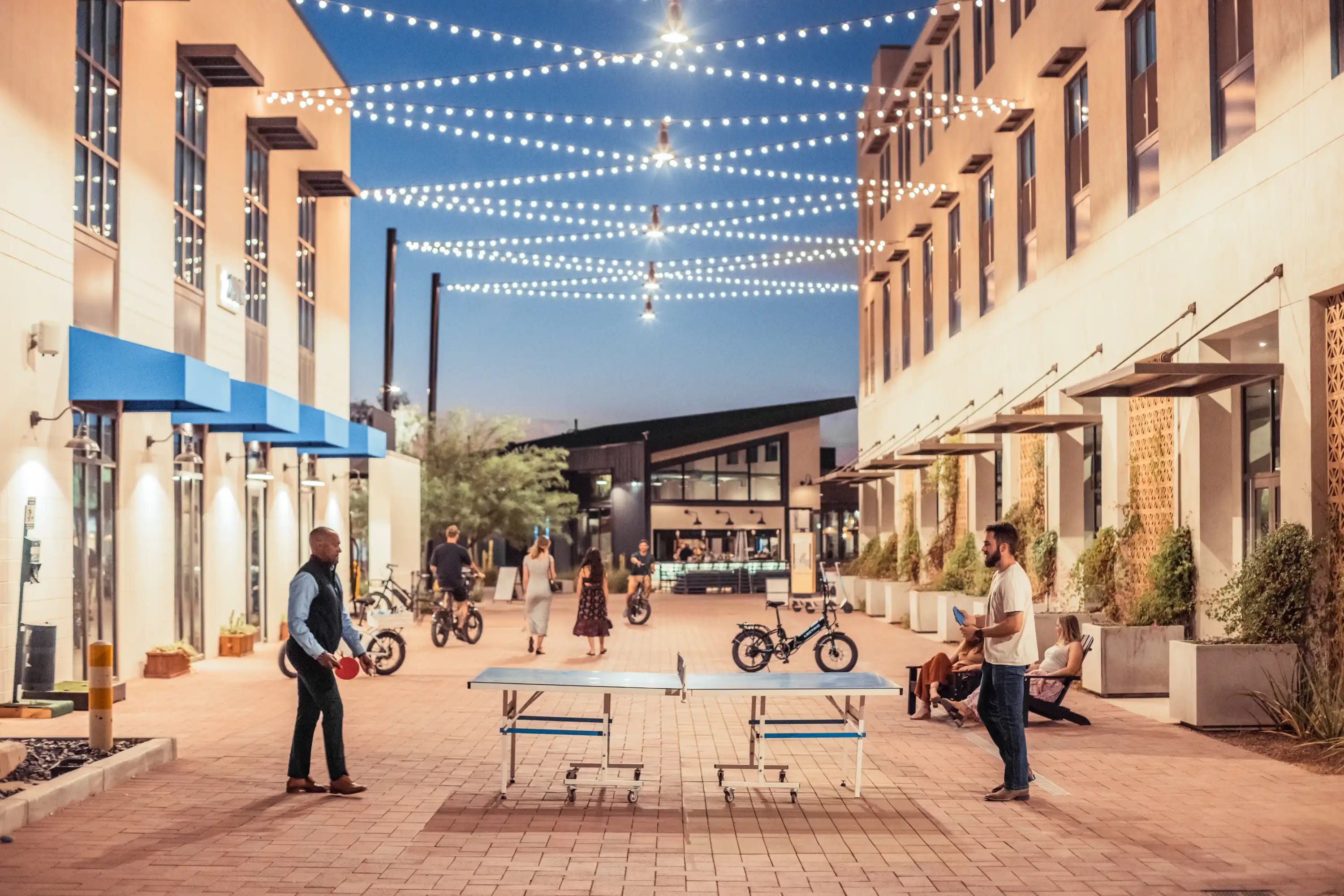
Residents use the light rail. They ride the e-bikes. The retail shops, which developers expected would take years to fill, grew from a handful to 22 businesses. One of them—Cocina Chiwas, by Armando Hernandez and Nadia Holguin—was nominated for a James Beard Award and named to the 2024 USA Today Restaurants of the Year list. Residents report knowing their neighbors, letting children play unsupervised in the plaza, and spending less money overall because they no longer own a car.
When Charles Montgomery, author of Happy City, visited, he described the development as “ideally configured to nurture a sense of belonging and neighborliness” in contrast to the alienation typical of car-dependent environments. The demographics are also broader than expected. What many assumed would be a narrow market of young ASU students has instead attracted families, older adults, and households across a range of incomes—the kind of diversity that often requires extensive policy intervention, but here emerges from the design of the place itself and the structure of the product.
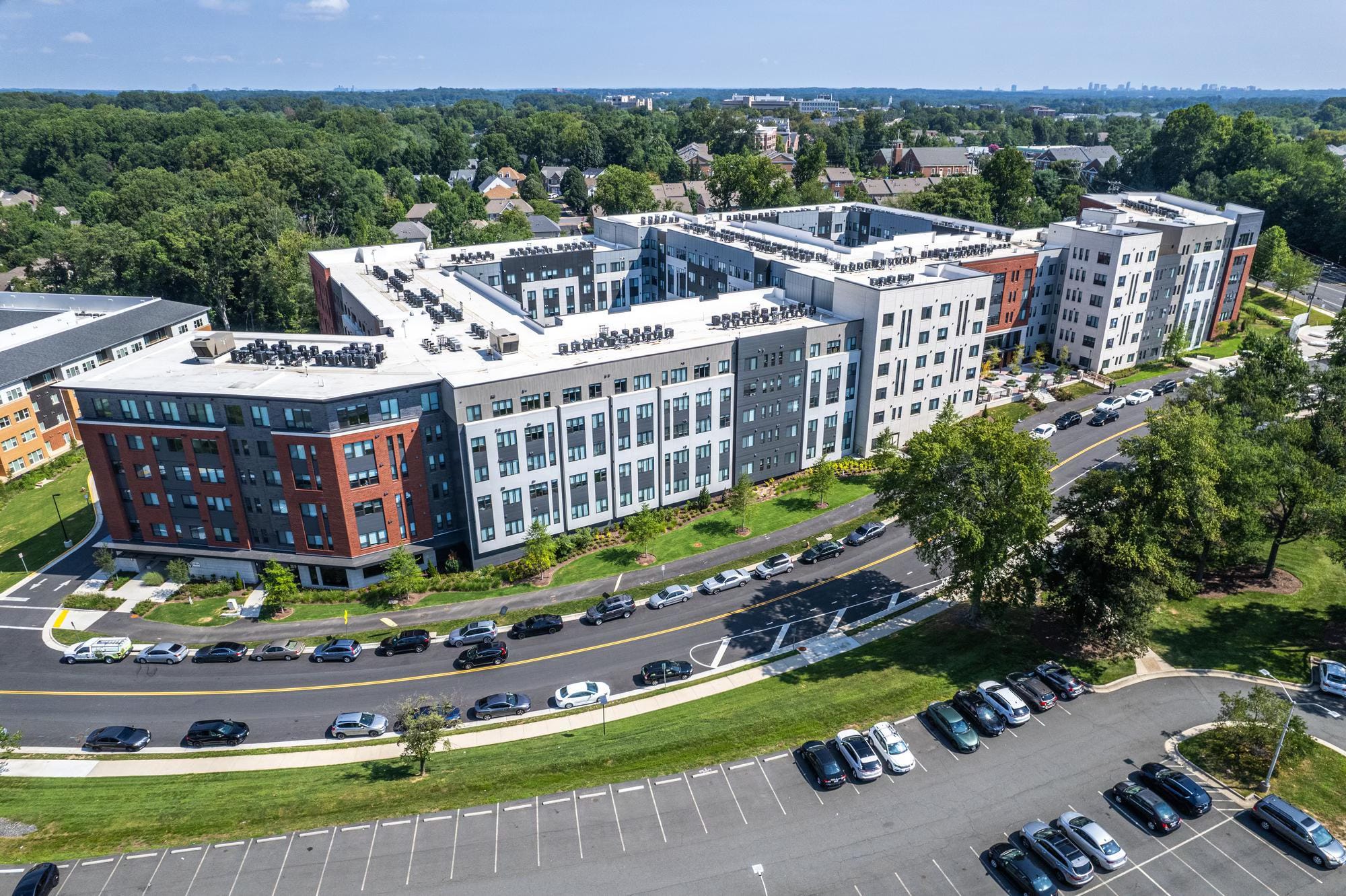
What is less discussed, but equally important, is that Culdesac breaks from the dominant building model that has come to define multifamily housing in the United States. Over the past two decades, most new rental housing has been delivered as large podium buildings: a single structure, organized around double-loaded corridors, sitting atop a concrete parking base. That model is not inevitable. It is the product of financing conventions, parking requirements and building regulations, and construction standardization. Culdesac takes a different approach. Instead of one large building, it is composed of many smaller buildings, each with its own circulation, scale, and relationship to the ground. The result is a finer-grained environment that feels closer to a traditional neighborhood than to a single real estate product. This matters because it suggests that density does not require megastructures. It can be achieved through aggregation—many buildings, closely arranged—rather than consolidation into one.
Where It Leaves Room to Grow
Culdesac Tempe is an important first step. It proves that car-free living can work in an American context and that there is real demand for a neighborhood organized around people rather than parking. As a first built example, it also clarifies where the model can evolve, and many of those next steps have already been anticipated by the team behind it.
Some of that evolution has to do with structure. This is a single, large development delivered by one team, with a consistent architectural language and unified ownership. That approach made it possible to bring a new idea to market, but over time, the strongest neighborhoods tend to incorporate more variety: more buildings, more authors, more variation within a shared framework. Similarly, all of the units at Culdesac are rentals within a single ownership structure. That simplifies delivery, but future iterations may incorporate a broader mix of tenure, including for-sale units and smaller-scale ownership, allowing more households to put down roots and participate in the long-term life of the neighborhood.
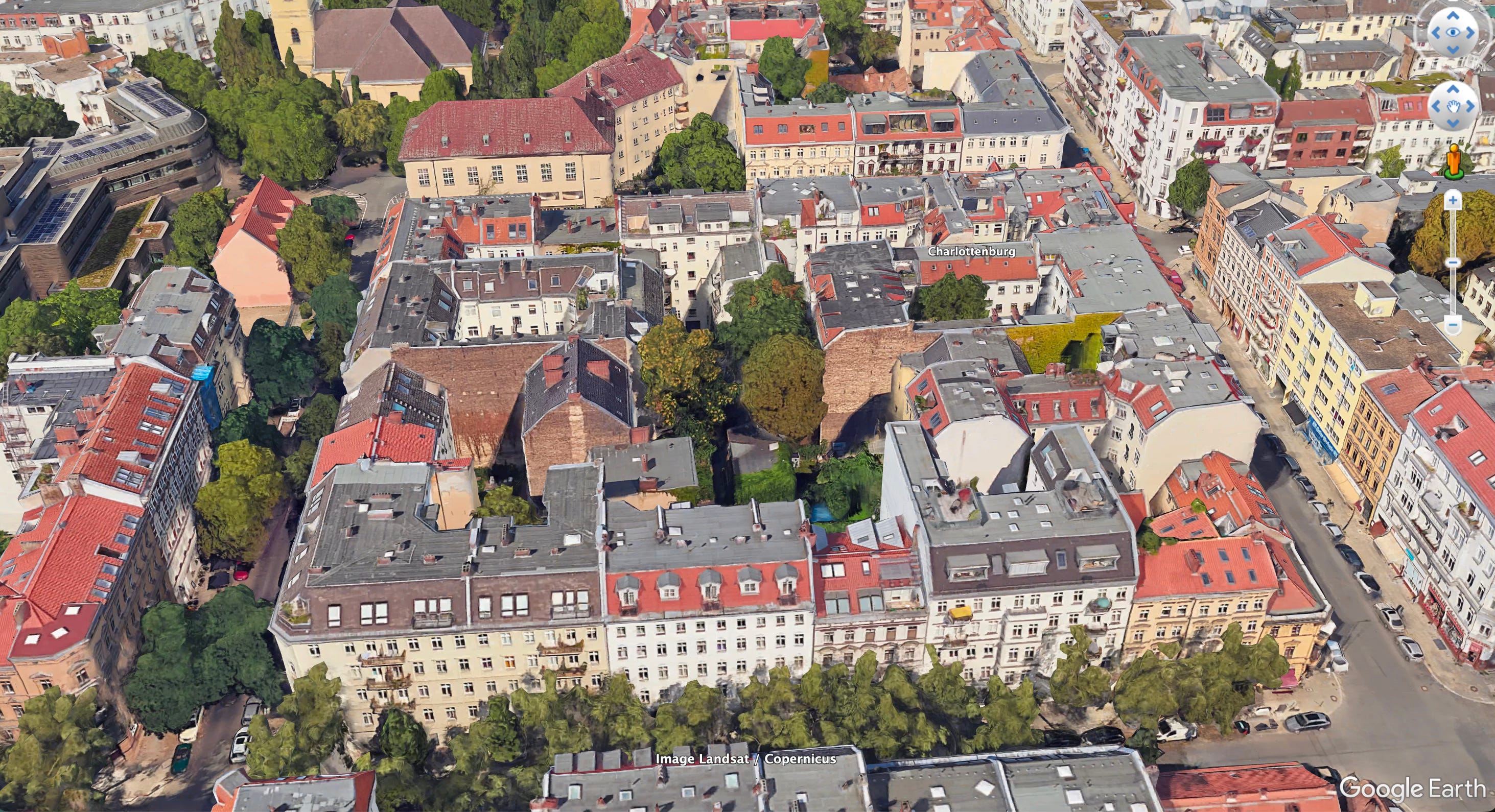
There is also the question of context. Culdesac’s success in Tempe is closely tied to its proximity to light rail and a supportive local policy environment. Within the neighborhood, daily life works without a car. Beyond it, the surrounding region still operates on a different set of assumptions. That gap is not unique to Culdesac; it reflects the broader condition of most American metros, where transit and land use are still catching up to one another.
As the model begins to expand, it is already adapting. A planned project along the Atlanta Beltline did not move forward, underscoring the complexity of delivering this kind of development in different regulatory and financial contexts. A subsequent project in Mesa takes a different approach, introducing a car-light model with some parking included. That shift reflects local conditions rather than a retreat from the core idea. In many cities, reducing dependence on cars will be a more immediate and scalable step than eliminating it entirely.
This points toward a broader range of future applications. Some sites, especially those with strong transit, can support fully car-free living. Others may evolve toward car-light configurations that significantly reduce parking while still accommodating a mix of household needs. In my own courtyard block work, that translates into small buildings with limited on-site parking: enough to support families and longer-term residents, while still prioritizing shared space and walkability.
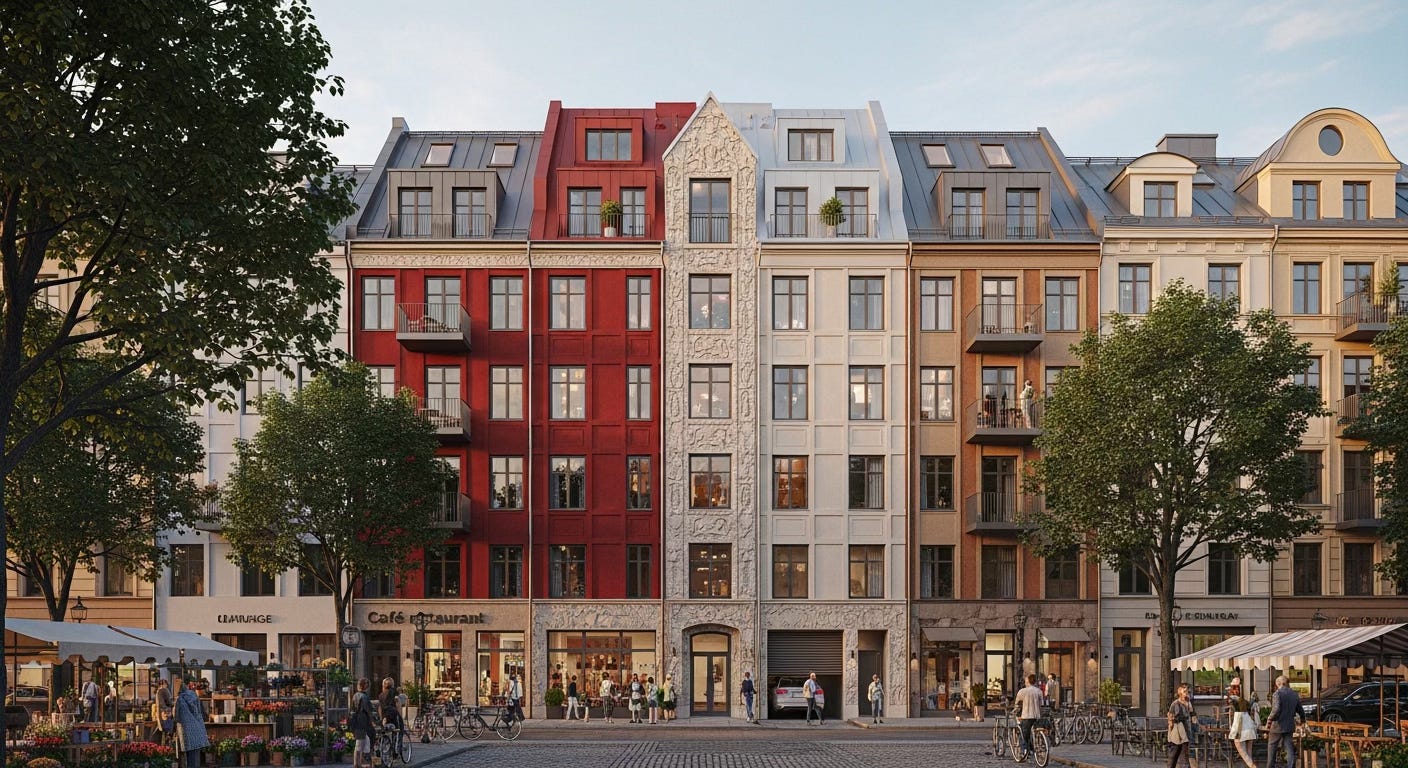
Culdesac demonstrates that it is possible to build walkable neighborhoods. The next phase is about expanding that possibility across more sites and more ownership structures so that it can support a full range of households and become a durable part of the American development landscape.
Why the Tweet Matters
The tweet matters because it captures a reversal that is a feature of so many great stories. What began as something dismissed, even ridiculed, returns as something sought after. The arc moves from dismissal to validation, from impossibility to demand. That shift is not just rhetorical. It marks a change in how an idea is perceived, and more importantly, in how it is acted upon.
When Culdesac started in 2018, asking an American city to waive its parking minimums for a residential development was a radical ask. Tempe agreed under a specific set of conditions: a transit-oriented zoning overlay along Apache Boulevard, a corridor in need of activation, and a developer willing to spend years building relationships with city officials and transportation partners before breaking ground. None of that was easy or inevitable.
Seven years later, city leaders are flying in from across the country to walk the paseos and ask how to replicate it. That is what proof of concept looks like when it works. The idea no longer needs to be argued for in the abstract. It has been built, occupied, and tested in the real world.
This does not mean every city will immediately eliminate parking requirements. The Mesa project shows how slowly those shifts occur and how models adapt to local conditions. But the terms of the conversation have changed. The question is no longer whether this kind of neighborhood can exist. It is how, and where, it can be built next.
The building exists. People live there. They know their neighbors. They structure their daily lives differently.
For the courtyard urbanism I advocate for, Culdesac is not a direct model. Courtyards and car-free neighborhoods operate on different logics and draw from different precedents. But they begin from the same premise: that American cities have been organized around the wrong priorities, and that demonstrating a better alternative in physical form carries more weight than any policy argument.
To family-friendly courtyards in America.
See you then,
Alicia Pederson
Courtyard Urbanist
It’s amazing to see something you’d see at some level in most Mediterranean countries where the narrow thoroughfares control temperature through mutual shading. Agree, that the ideal is to see this emerge organically with a mix of ownership and tenure, which makes it more resilient as it ages. The thing you see in the European context (and in Japan) is there are cars, but they are much smaller and don’t dominate the streetscape.
A minor correction that does not detract from your excellent piece: Breaking Bad, BCS and Pluribus take place in Albuquerque, not Phoenix