


Yesterday I posted a split-screen image on X/Twitter. One image showed valuable urban land used in an intelligent and pro-social manner. The other showed valuable urban land used ineptly as box stores and parking lots.
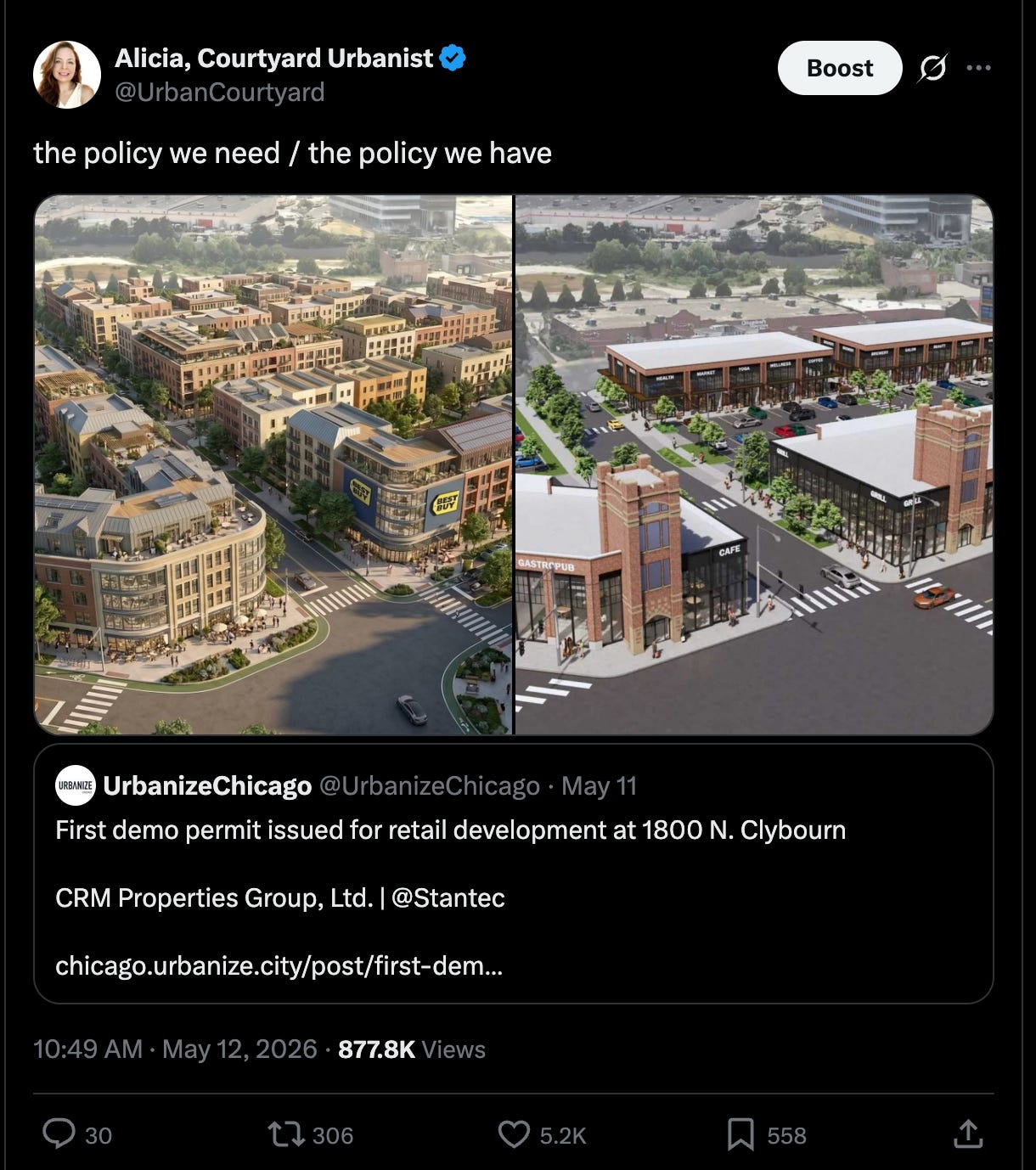
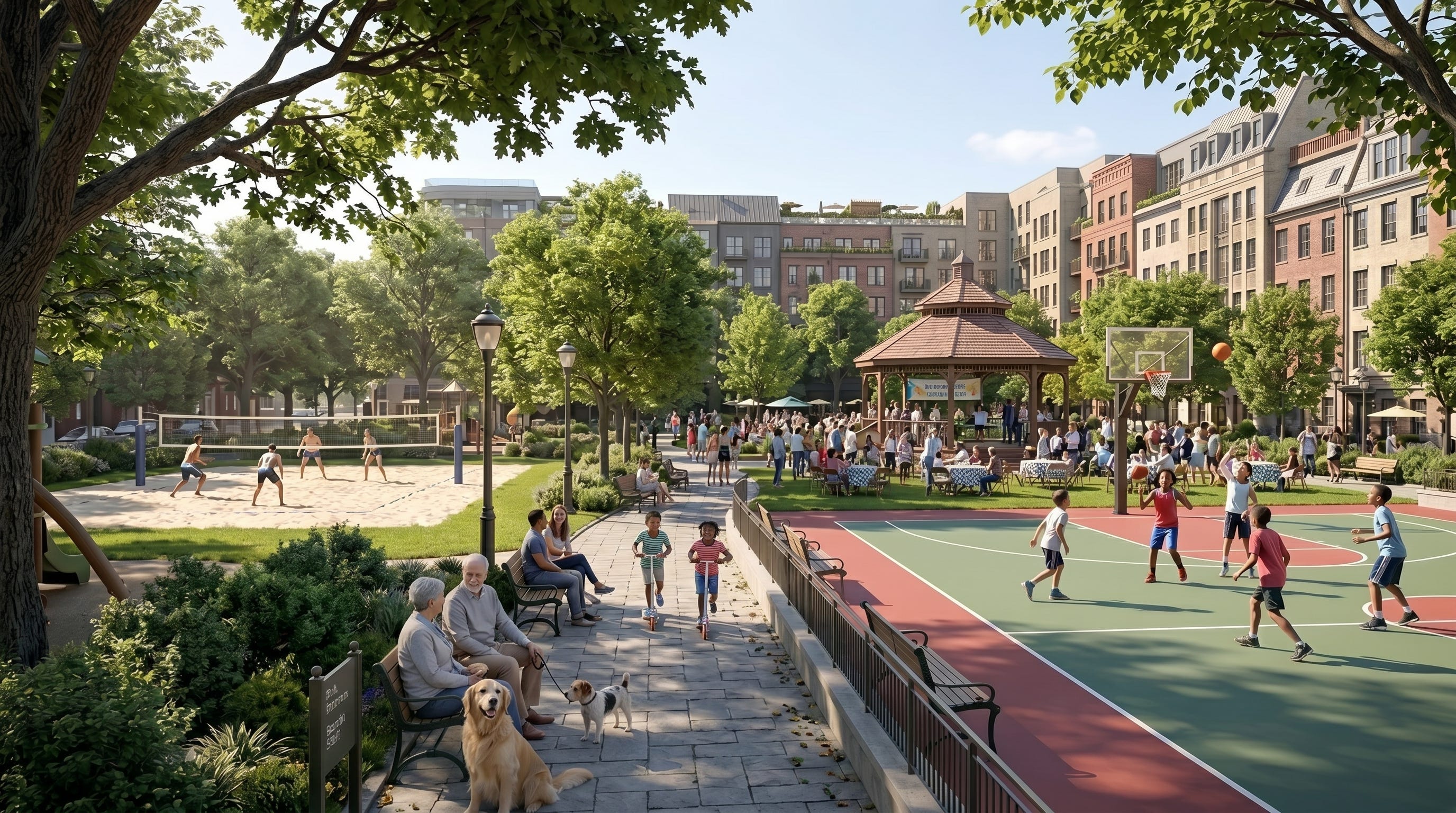
On the left, we have a dense, walkable, mixed-use courtyard neighborhood. Five- and six-story buildings. Shops at the ground floor, housing above. Trees, narrow, active streets, many different buildings, balconies, active rooftops, internal courtyards, many front doors. It looks urban and urbane and, at the same time, comfortable and livable.
On the right, we have the version now, to everyone’s horror, moving through the city: an updated retail plaza with abundant parking. An architectural rendering mocking us with the monstrosity of our drive-everywhere lifestyle.
The caption is short and obvious:
the policy we need / the policy we have
It went viral because it made the point that these two development outcomes, one fantastically appealing and the other depressing, are downstream of policy, not market demand.
The post was responding to an Urbanize Chicago story about the first demolition permit for the redevelopment of Clybourn Place, the aging retail complex at 1800 N. Clybourn. The current plan would replace the existing buildings with five new retail structures totaling about 43,900 square feet, surrounded by roughly 200 surface parking spaces. It will be newer, cleaner, and presumably easier to lease than what is there now.
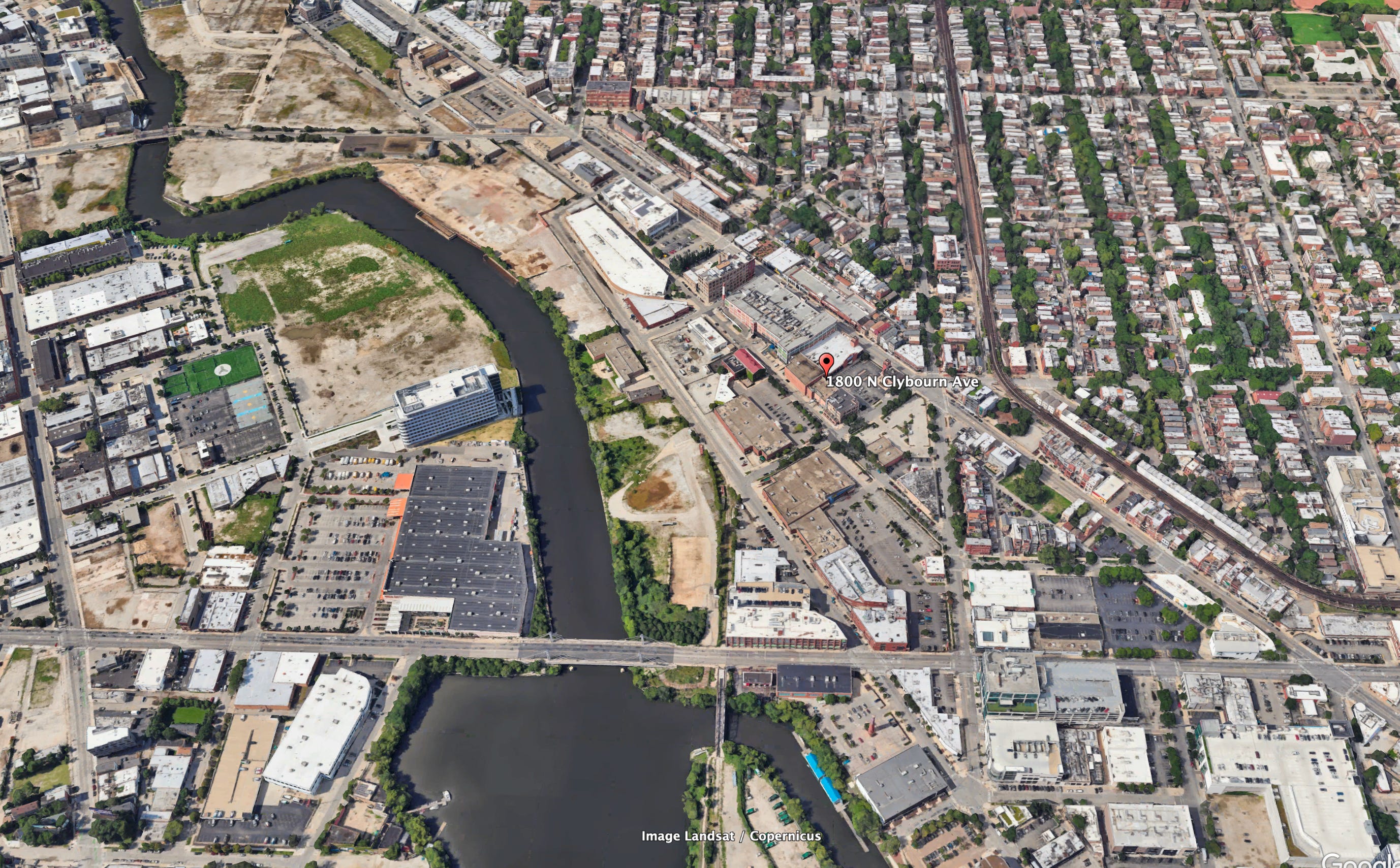
But it is also a heart-breaking underuse of land in a neighborhood with extreme demand for family homes. It sits in the middle of the North Side, near Lincoln Park, Old Town, Bucktown, Wicker Park, DePaul, Armitage, Halsted, the Red Line, the river, and downtown. It is close to jobs, transit, schools, parks, restaurants, and some of the most expensive housing in the city. Four-bedroom housing is generally a $1.5M–$2.5M product if it is a condo/townhome, and often $2.5M–$5M+ if it is a single-family house (only housing type currently that offers yard access). In any rational land-use system, this would be an obvious place for housing over shops.
The appalling reason this is happening is that Clybourn is old industrial land that never became a neighborhood—and is now frozen in commercial under-development by laws that forbid residential construction, require excessive parking, and preserve parcels at a scale too large for ordinary neighborhood building. The problem is not only that Chicago makes mixed-use housing hard. It is that even when housing is allowed, our rules keep land in giant parcels, which means the market delivers giant projects: towers, podiums, lifestyle centers, or retail boxes with parking. To turn obsolete commercial corridors into real neighborhoods, Chicago needs two reforms at once: mixed-use zoning, so people can live above shops and services, and small-parcel zoning, so large sites can be broken into many buildings, many front doors, many owners, many unit types, and many yards. This article explains how Clybourn got stuck in this condition, why courtyard block development is the right strategy for sites like this, and what city governments, aldermen, developers, and ordinary citizens can do to make it possible.
Clybourn is old industrial land that never became a neighborhood
Like many commercial zones, Clybourn is the remnant of an older industrial site. Unlike the dense, fine-grained neighborhoods of Lincoln Park, Old Town, Wicker Park, Bucktown, or Lakeview, it was not built block by block, lot by lot, building by building, with many owners and many small parcels gradually forming a neighborhood. It was built around larger, coarse-grained parcels: factories, warehouses, rail-adjacent uses, and commercial buildings that never joined the fine-grained residential fabric around them.


As industry receded from the North Side, these parcels did not evolve into a normal neighborhood. According to car-oriented land use norms of the late 20th century, the parcels were redeveloped as big-box stores, entertainment uses, shopping-center formats, and acres of surface parking.
This pattern is common across American cities. Large obsolete industrial parcels get repurposed as new drive-to retail formats that did not fit comfortably into older neighborhood streets. Their land was close enough to wealthy neighborhoods to be commercially valuable, but not protected by the same pedestrian-friendly, fine-grained urban fabric. This is why we have so much urban land used in a car-oriented, suburban way.


The large parcels are anathema to great neighborhoods. The neighborhoods that work—the ones people love, defend, and pay extraordinary sums to live in—are fine-grained. They are built on grids, where blocks of land are divided into many smaller parcels. They are made by many owners, many builders, many architects, and many decisions over time. They contain many buildings, many front doors, many unit types, many price points, many architectural expressions, and many ways of living.


That fine-grained pattern also makes yards possible. You cannot have a real neighborhood without some form of outdoor domestic life: rear yards, courtyards, gardens, stoops, balconies, roof terraces, shared greens. Even dense neighborhoods need yards. Especially dense neighborhoods need yards.
City blocks work best when they balance public street life with private and semi-private outdoor space. Buildings maintain the street edge, but behind them are domestic spaces where children play, gardens grow, residents grill, host outdoor dinners, and maintain bikes. The block is, yes, building mass, but it is also the outdoor spaces and the social relationships they nurture.
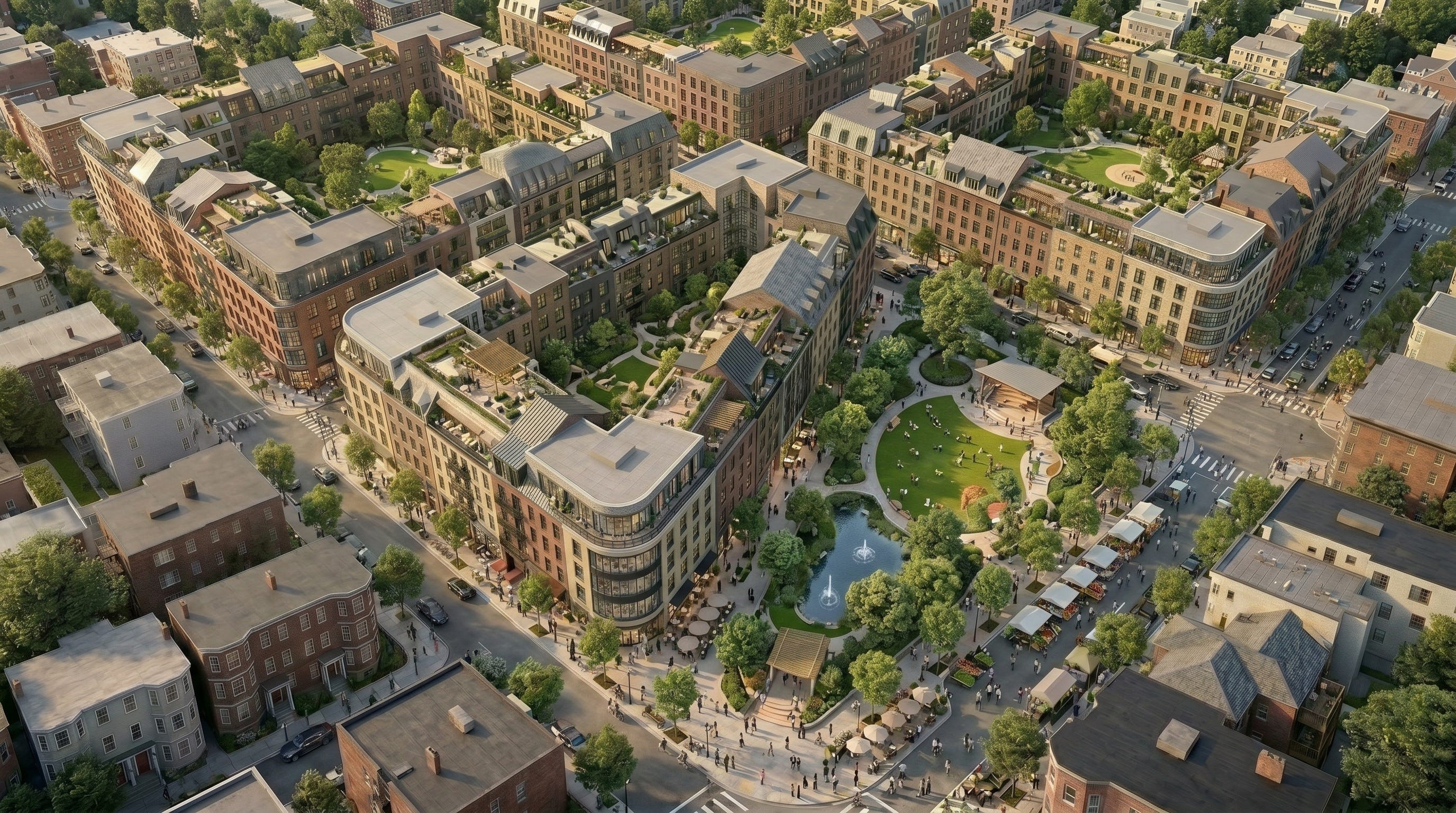
Coarse-grained development, the only kind we seem to know how to build now, struggles to do this. A giant parcel becomes a giant building, or a giant retail box, or a giant parking lot, or a giant podium. It may contain amenities in expensive amenity decks that drive up per-unit construction costs and keep residents from patronizing gyms or cafes in their neighborhood. It does not create the same relationship between street, building, home, and yard. It does not create many owners or many buildings. It does not create the layered social and architectural texture that makes old urban neighborhoods work.


How do we get from coarse-grained development back to fine-grained development?
No fine-grained neighborhoods without policy that supports subdivision into smaller, mixed-use parcels
The most important fact about 1800 N. Clybourn is the entitlement. The site is governed by Planned Development No. 399, a commercial planned development from another era. The PD permits commercial uses and excludes residential uses. It also requires a large amount of off-street parking and treating part of the property as land for cars.
A retail redevelopment can move forward under the existing rules. A real mixed-use neighborhood cannot. Housing would require reopening the planned development, entering the rezoning process, and exposing the project to delay, negotiation, aldermanic discretion, neighborhood opposition, and all the uncertainty that comes with discretionary approval.
However, the larger problem here is that, even when housing is finally allowed on sites like this, the regulatory and financial system tends to produce one enormous project on one enormous parcel. So, mixed-use zoning is necessary but not sufficient.


Mixed-use zoning answers the use question: can housing, shops, childcare, groceries, clinics, offices, and restaurants coexist on the same site? The answer should obviously be yes. But small-parcel zoning answers the urbanism question: will the site become a neighborhood, or will it become a megaproject?
A single large parcel, even when rezoned for housing, usually invites a single large building: a tower, a podium, a lifestyle center, or some hybrid of all three. The parcel is the hidden unit of urban form. If the parcel is enormous, the project will tend to be enormous. If the parcel is broken into many buildable pieces, many buildings become possible. And with many buildings come many doors, many storefronts, many owners, many architects, many unit types, many price points, and many ways for the place to evolve over time.
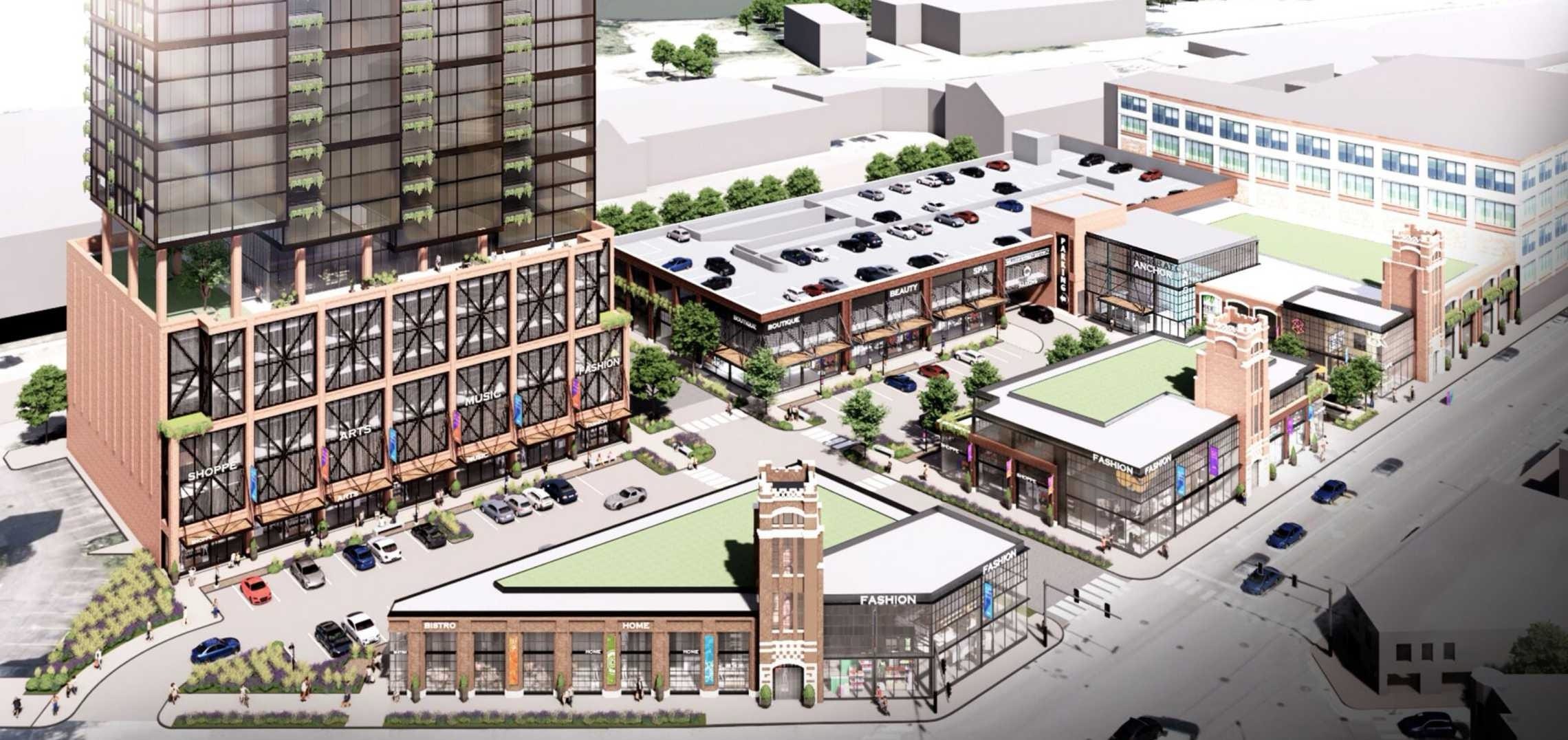
There was, at one point, a more ambitious version of the Clybourn project. Earlier reporting described a possible second phase: a 500-unit residential tower rising roughly 520 feet, with ground-floor retail and structured parking. The developer may return to this proposal in the coming years, reviving the residential component when they are ready to fight for the right to build housing.
However, even if the tower is eventually built, it will not create the fine-grained, complete life-cycle neighborhood that everyone wants and no one delivers anymore. A 500-foot tower will add more units. But towers are an expensive way to produce urban housing. They require large capital stacks, long entitlement periods, complex engineering, structured parking, costly vertical circulation, and high rents. They also tend to produce a predictable unit mix: many studios and one-bedrooms, some two-bedrooms, and relatively few family-sized units.
Part of the problem is economic. When each unit has to absorb the cost of elevators, structure, mechanical systems, amenity packages, structured parking, financing risk, and years of entitlement uncertainty, the pressure is toward smaller, higher-rent apartments.
But part of the problem is architectural. Towers are usually built around deep floorplates: a compact central core of elevators, stairs, shafts, and corridors, surrounded by apartments arranged along the exterior wall. This works well for small units, because a studio or one-bedroom only needs a limited amount of window frontage. It works much less well for large family apartments, which need more bedrooms, more interior doors, more storage, more circulation, and more access to daylight


The deeper the floorplate, the harder it becomes to give every bedroom a window without making the unit very wide along the facade. A three- or four-bedroom apartment needs a lot of perimeter frontage, and in a tower that frontage is expensive and scarce. Consequently, large tower units are costly and awkward. The building’s geometry itself selects for smaller apartments.
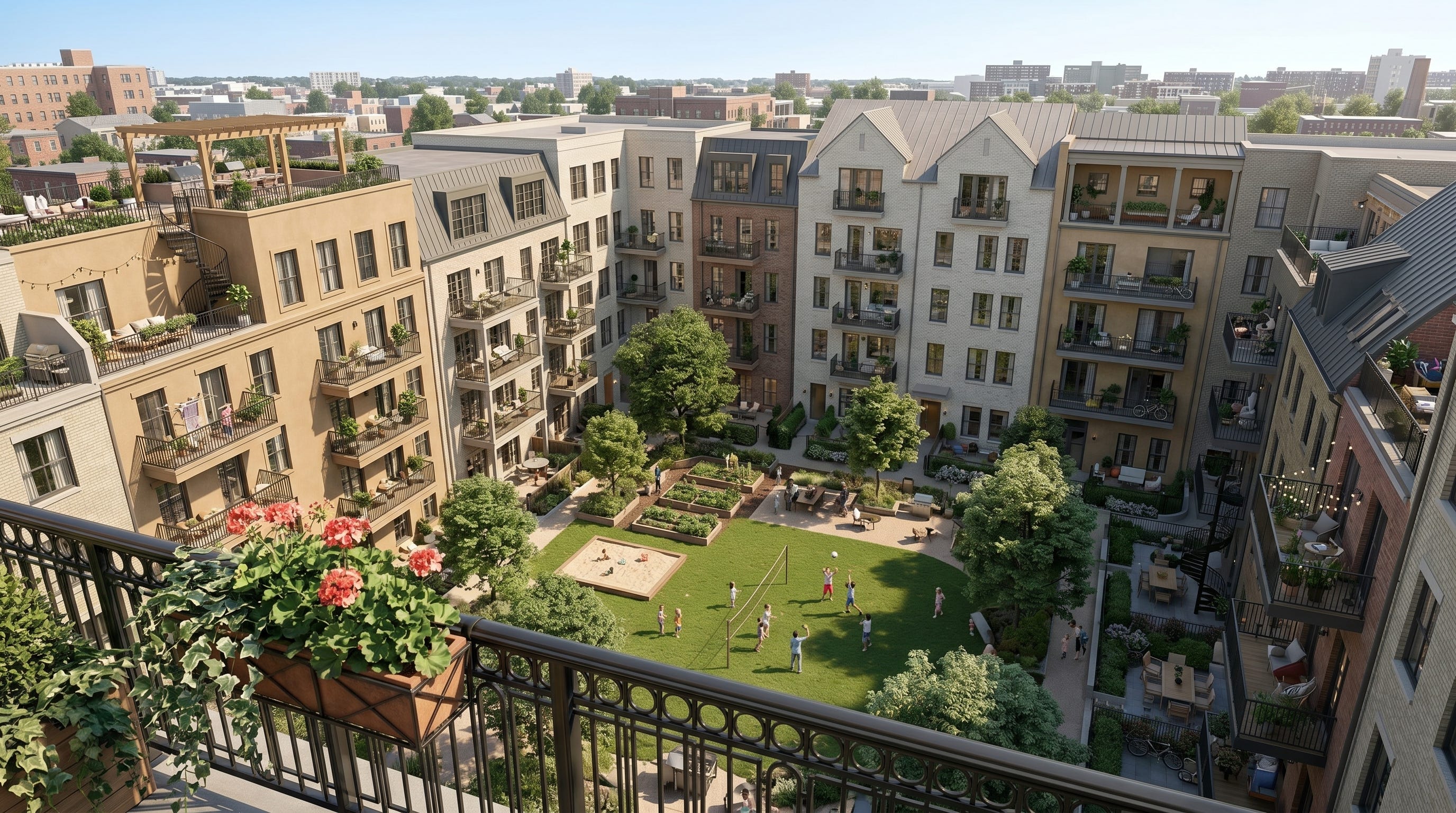
By contrast, courtyard blocks use shallower buildings arranged around open space, creating more exterior wall per unit, more opportunities for cross-ventilation, and more workable layouts for two-, three-, and four-bedroom homes. Instead of concentrating hundreds of apartments around a vertical core, they distribute housing across many smaller buildings with more light, more frontage, and more direct access to yards, courtyards, balconies, and streets.


The policy we need would make courtyard blocks legal on sites like this. As the normal form of urban redevelopment.
This is what captured the public imagination with the viral tweet. The vision of the retail plaza redeveloped not as a tower surrounded by parking lots and commercial buildings. But as five- and six-story buildings lining streets and built to the sidewalk. Ground floors active with small shops, cafes, childcare, groceries, clinics, workshops, co-working spaces, and neighborhood services. Upper floors would hold apartments. Some would be small. Many would be family-sized. Buildings would be shallow enough to allow dual-aspect units: common areas and secondary bedrooms facing street, kitchens and primary bedroom facing inward toward shared courtyards at the heart of every block.


This is the urban form that American cities have to legalize if they want a future. It is dense without being a tower. It is green without being suburban. It is mixed-use without being a megaproject. It creates a strong public realm on the street and a protected common realm inside the block.
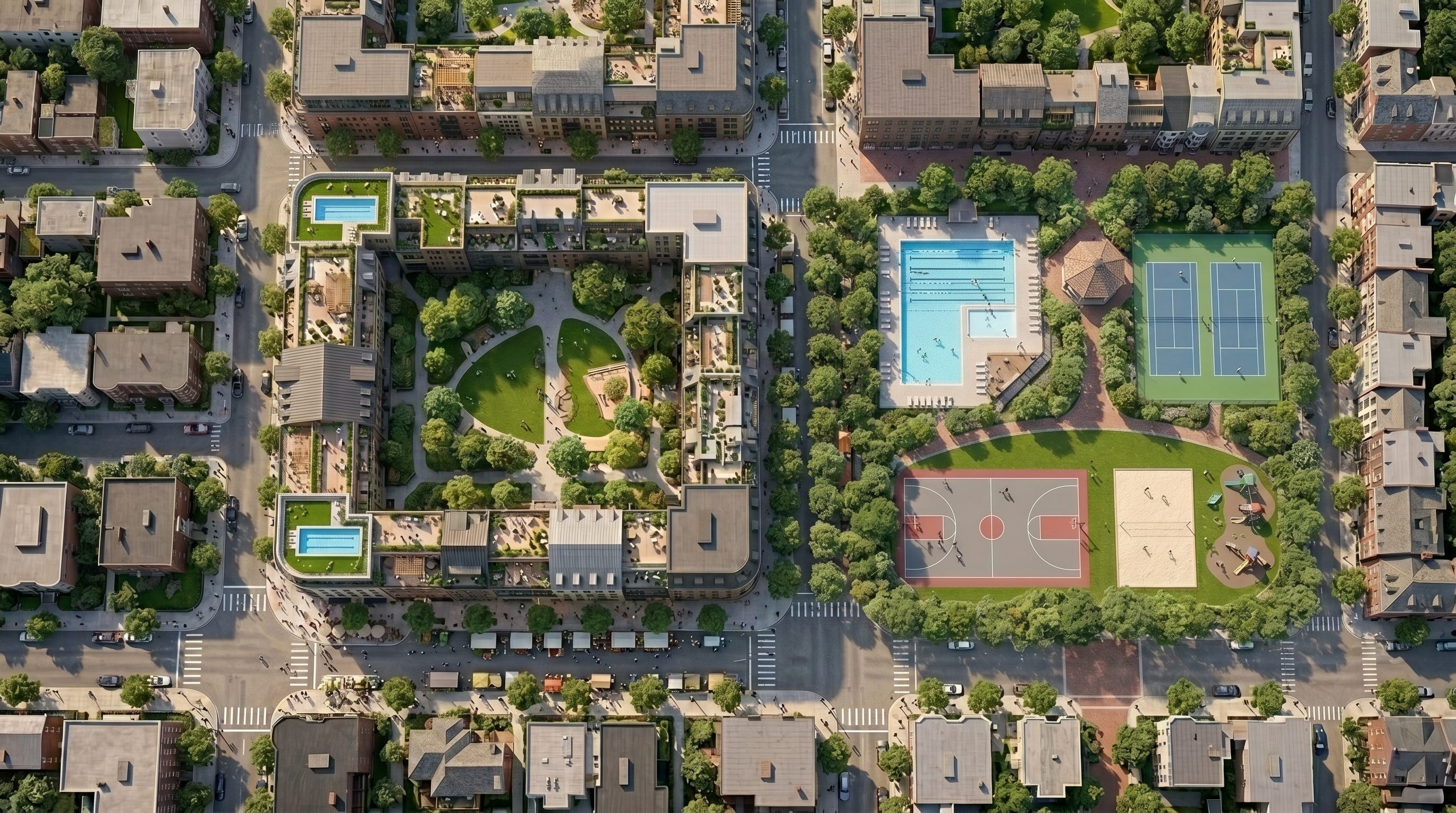
It also distributes ownership, architecture, and risk. Instead of one huge building consuming the entire site, a courtyard-block strategy could be made of many smaller buildings, many facades, many entries, and potentially many builders. And they would all be building at much lower construction costs, both because smaller buildings are less costly to build and because they come with less red tape.
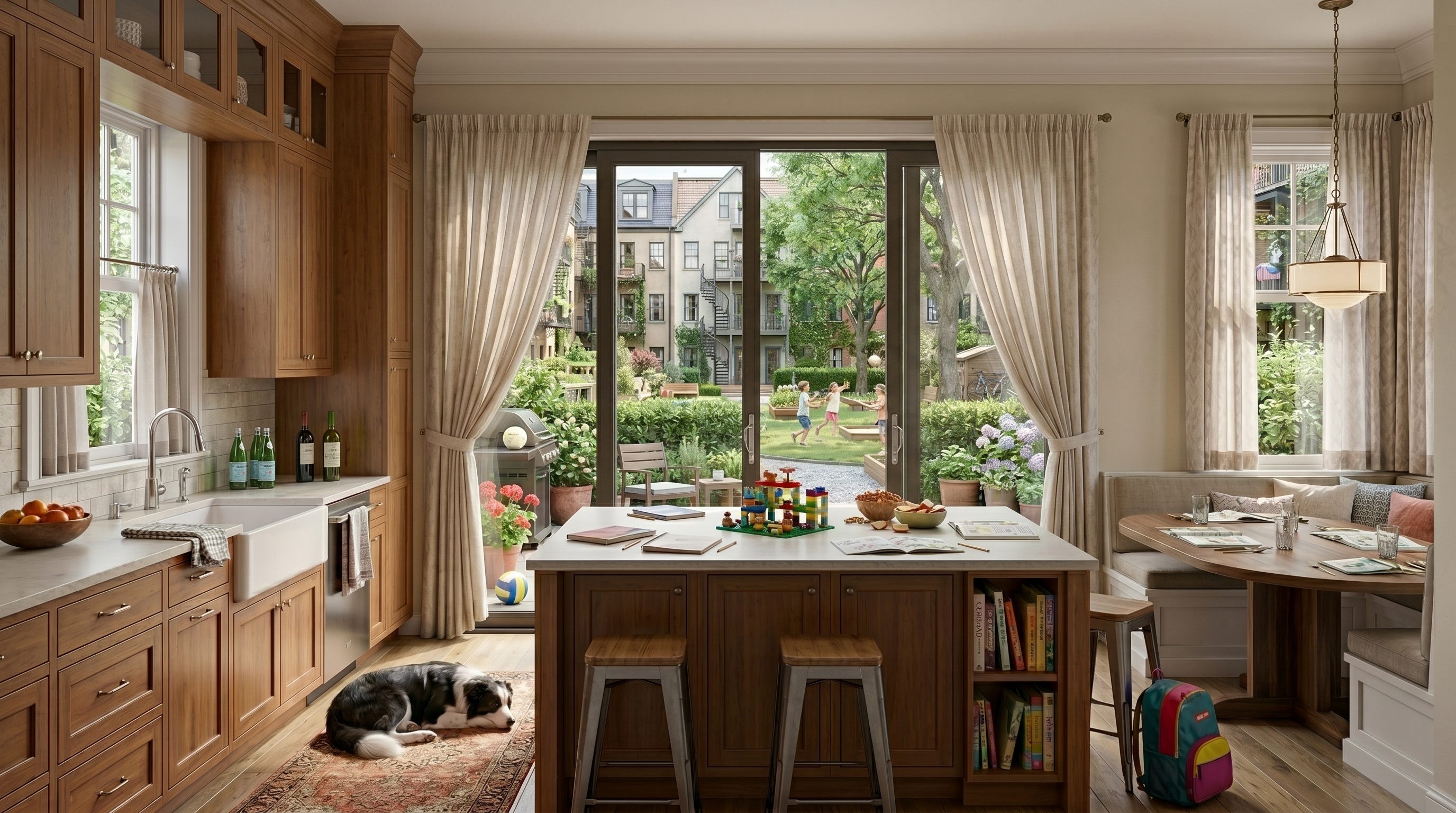
A neighborhood made of many buildings can change over time. It can hold different tenures, different rent levels, different household sizes, different businesses, different architectural expressions. It can absorb shocks better than a single megastructure. It can become more valuable and more loved as it ages.
Next steps for reviving Clybourn and similar commercial zones
It’s fun to complain about bad things, but how do we fix them? What is the policy pathway for the kind of neighborhood Chicago actually needs?
City Council could act citywide. It could direct DPD to create a new commercial-corridor neighborhood overlay for obsolete industrial and auto-oriented retail land: places like Clybourn, Elston, parts of Western, Ashland, North, and other corridors where large parcels, surface parking, and weak pedestrian environments suppress the possibility of real neighborhood life. The overlay should legalize mid-rise mixed-use courtyard blocks by right, remove or sharply reduce parking requirements, permit zero setbacks and party-wall construction, require active ground floors on major streets, and make subdivision into 40- to 70-foot parcels the default rather than the exception. It should also create a pattern-book or pre-approved design catalogue: small apartment buildings, corner buildings, courtyard buildings, live-work buildings, family-sized flats, and mixed-use buildings that can be assembled block by block.
Alderman Hopkins could act immediately on Clybourn. He could convene a public working group on the future of the 1800 N. Clybourn corridor, ask DPD to study a fine-grained mixed-use alternative, and make clear that the ward’s long-term goal should not be another drive-to retail format followed later by an isolated tower. He could ask the developer to show a courtyard-block scenario alongside the currently permitted retail scheme and any future tower plan. He could also introduce, co-sponsor, or publicly request an overlay for Clybourn that allows parcelization, mid-rise housing, active ground floors, and reduced parking. His office lists office@aldermanhopkins.com as the public email contact, with a service office phone of (312) 643-2299. Send him this article!
Car-dependency, housing scarcity, and visual blight are not inevitable. The current condition was made by law, and it can be remade by law. We do not have to accept obsolete industrial corridors, retail boxes, and parking lots as if they were natural facts. We can decide what kind of city we want, write rules that serve those goals, and make the law work for our own interests: more housing, more beauty, more walkability, more local businesses, more family life, and more complete neighborhoods
.