


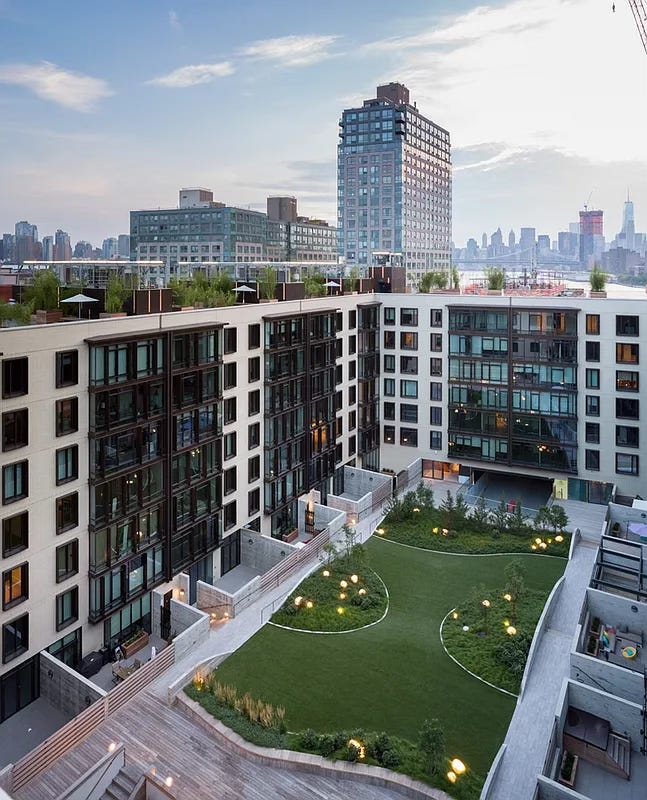
In 2015, a Chinese developer hired a Dutch architect to build something almost unheard of in the United States: a true European-style courtyard block.
The result was The Oosten, a 216-unit condominium building occupying an entire city block in Williamsburg, Brooklyn.
It is among the most serious attempt to build a courtyard block in modern America.
It’s also a luxury development, with studios starting around $1.2M and three-bedroom units selling for over $2M.
The Oosten shows that courtyard blocks can be built in the United States—but without smaller parcels they tend to become luxury megaprojects rather than diverse neighborhoods.
Today I want to break down the Oosten project:
What the Oosten is
What the Oosten gets right
What it gets wrong
What it means for American courtyard development
1. What the Oosten Is


The Oosten sits at 429 Kent Avenue in South Williamsburg, a few blocks from the East River waterfront.
Designed by Dutch architect Piet Boon and developed by XIN Development Group International (the U.S. arm of Chinese developer Xinyuan Real Estate), it was completed in 2015 on a site of roughly 94,700 square feet—just over two acres.
The building is eight stories tall and contains 216 residential condominium units. In total, it comprises approximately 500,000 gross square feet of construction area, including 343,228 square feet of sellable residential space, according to engineering firm Langan’s project records.
The building also includes roughly 10,000 square feet of ground-floor community facility space, currently occupied by Brooklyn Global Prep, a private school. This small institutional tenant demonstrates how ground-floor commercial or community facility space in courtyard block developments can accommodate neighborhood-serving institutional uses, even within predominantly residential projects.
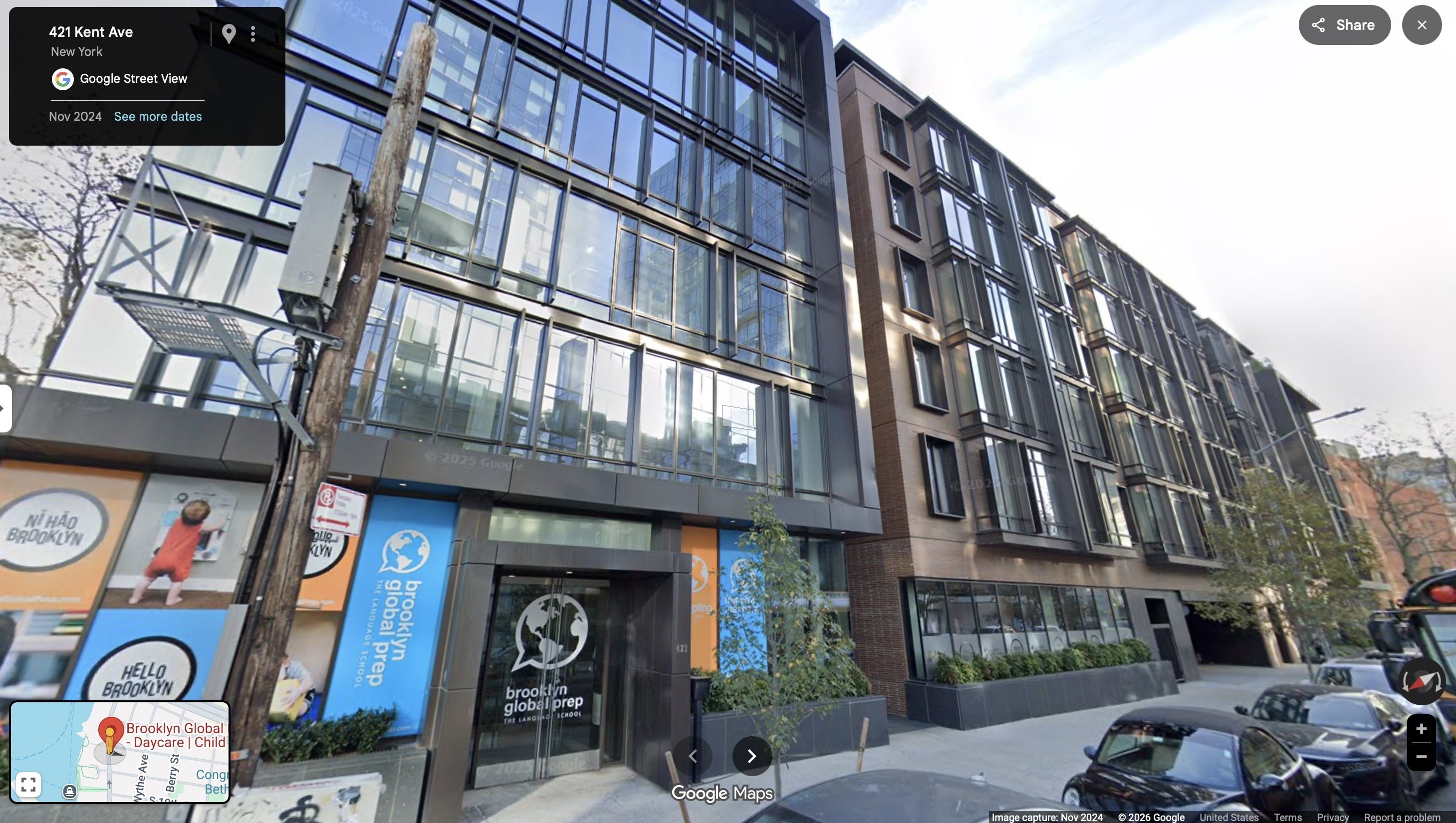
Boon organized the building as a true perimeter block:
The structure wraps the full perimeter of the lot
It encloses a central courtyard shared by residents
The courtyard sits on a structural slab above parking, but it is designed and accessed almost like a ground-level yard.
This is meaningfully different from the typical American “Texas Donut” configuration, where apartments wrap around interior parking garages.
The financials suggest the project was highly profitable


XIN acquired the site for $54.2 million in 2012, while the condominium offering plan projected roughly $400 million in total sales.
With roughly 500,000 gross square feet of construction, and mid-rise New York building costs in the mid-2010s typically estimated at $350–$500 per square foot, total development costs likely fell somewhere between $175–$250 million.
Current listings show:
One-bedrooms selling around $1,300 per square foot
Three-bedrooms around $1,070 per square foot
These prices reflect both the building’s quality and the dramatic appreciation of Williamsburg real estate over the past decade.
By any estimate, the Oosten was a financially successful luxury development.
2. What the Oosten Gets Right
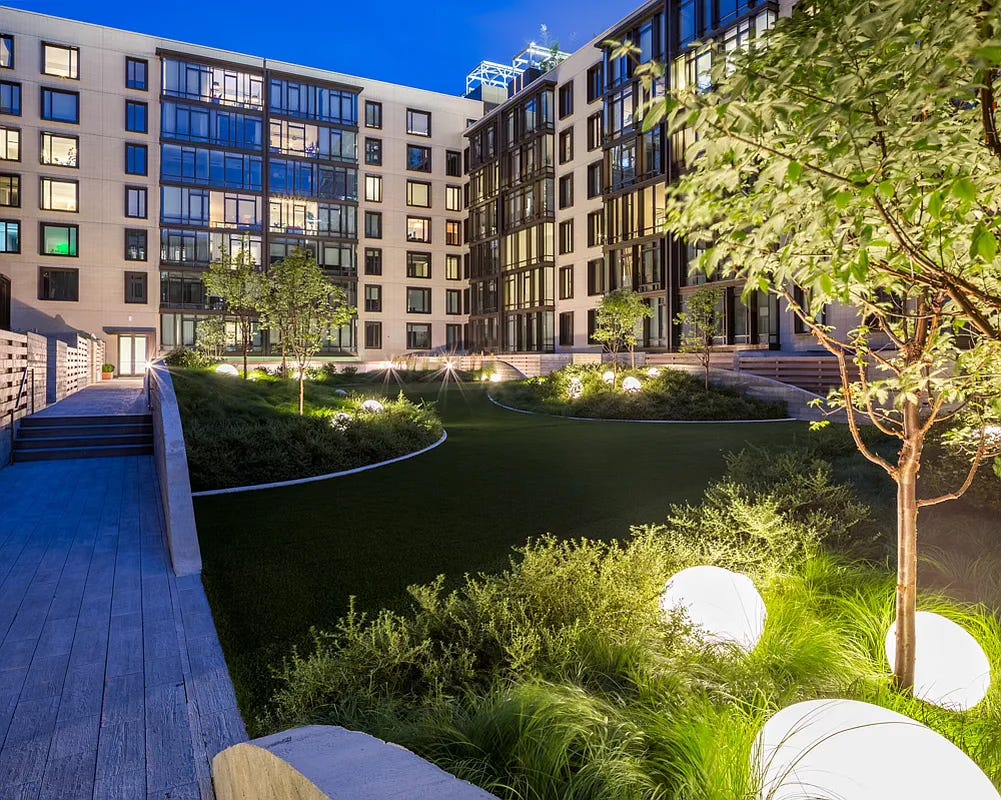
Let me be clear: The Oosten is a real accomplishment in urban form that demonstrates the tremendous value of perimeter block buildings.
The building creates a clear distinction between:
the public realm — Kent Avenue, the street, the city
the private realm — the shared courtyard interior
This is the fundamental spatial move that makes European courtyard blocks so livable, and it is rare in American multifamily construction.
Most American apartment buildings are either:
Towers in open space (no enclosure, no protected interior), or
Corridor buildings with single-loaded or double-loaded layouts facing one direction.
The Oosten gives residents something American apartments rarely offer:
A front door on the street
A private outdoor world behind them
A diverse unit mix


The building also accommodates households of very different sizes.
Piet Boon designed a wide range of apartments—from compact one-bedrooms to large five-bedroom duplexes suitable for families.
Many units have dual-aspect layouts, with windows facing both the public street and the private courtyard.
These are what I call “lives-like-a-house” units:
dual orientation
excellent natural light
rooms that feel properly proportioned rather than compressed along a corridor
The five-bedroom duplex plans circulating online are frankly extraordinary—large front-to-back homes that look nothing like typical American apartment units.


Serious urban density without towers
The building’s floor area ratio (FAR) of 3.62 on a two-acre site is also notable.
That’s impressive urban density, comparable to the mid-rise courtyard blocks found in cities like Copenhagen—achieved without towers and without eliminating private outdoor space.
3. What the Oosten Gets Wrong
Despite its strengths, the Oosten also demonstrates the drawbacks of monolithic megadevelopment.
The project was:
developed by one developer
designed by one architect
built all at once across an entire block
The result is architectural monotony, where the facades are competent but relentlessly uniform.
That is not how the courtyard blocks that inspire projects like this were historically produced.
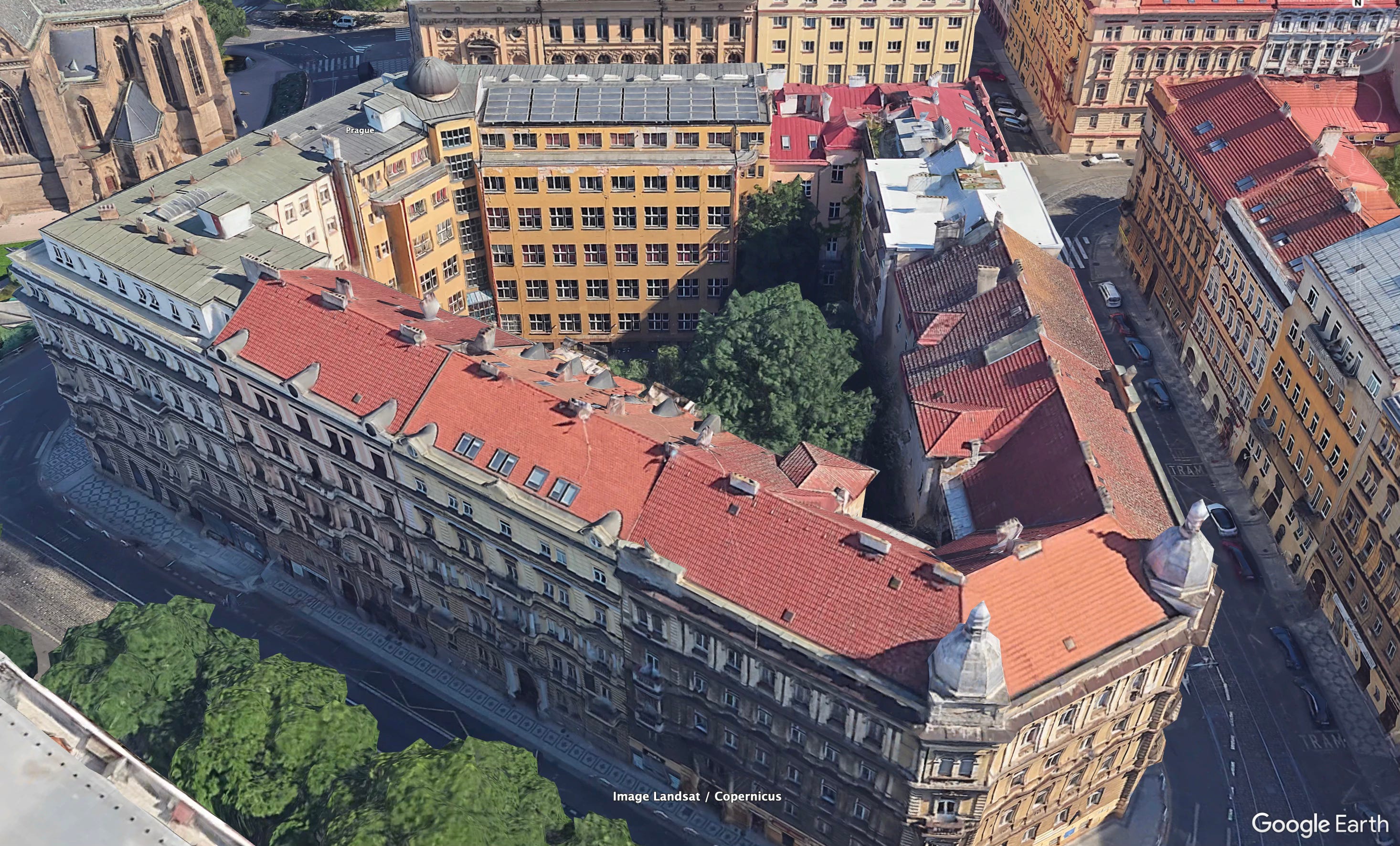
In cities like Berlin, Prague, or Stockholm, a perimeter block was rarely conceived as a single project.
Instead, blocks emerged incrementally:
different developers
different architects
different buildings
often built across decades
Each building has its own façade, stair configuration, floor plate, and ownership structure.
The coherence of the block comes from shared urban rules:
build to the lot line
maintain the street wall
roughly match cornice heights
Variety naturally emerges within these constraints.
This decentralized process produces the visual richness that makes historic European streets so compelling.
The Oosten gives you one architectural vision executed at block scale.
It’s a good vision—but it’s still just one.
A single luxury price bracket


Because the Oosten is a single condominium development, everything is bundled into one financial structure.
The pool, gym, concierge, and other amenities are baked directly into the cost of every unit.
At roughly $1,000–$1,300 per square foot, the building functions as a single luxury housing product.
Historic courtyard blocks were rarely structured this way.
In cities like Berlin or Copenhagen, the same block often contains:
condominiums
rentals
large family apartments
smaller walk-up units
This diversity emerges because the block is composed of many buildings rather than one.
Fragmentation allows for:
different price points
different ownership models
different household types
The Oosten has a wide range of unit sizes, but they all sit inside the same luxury pricing structure.
A courtyard built like an amenity deck
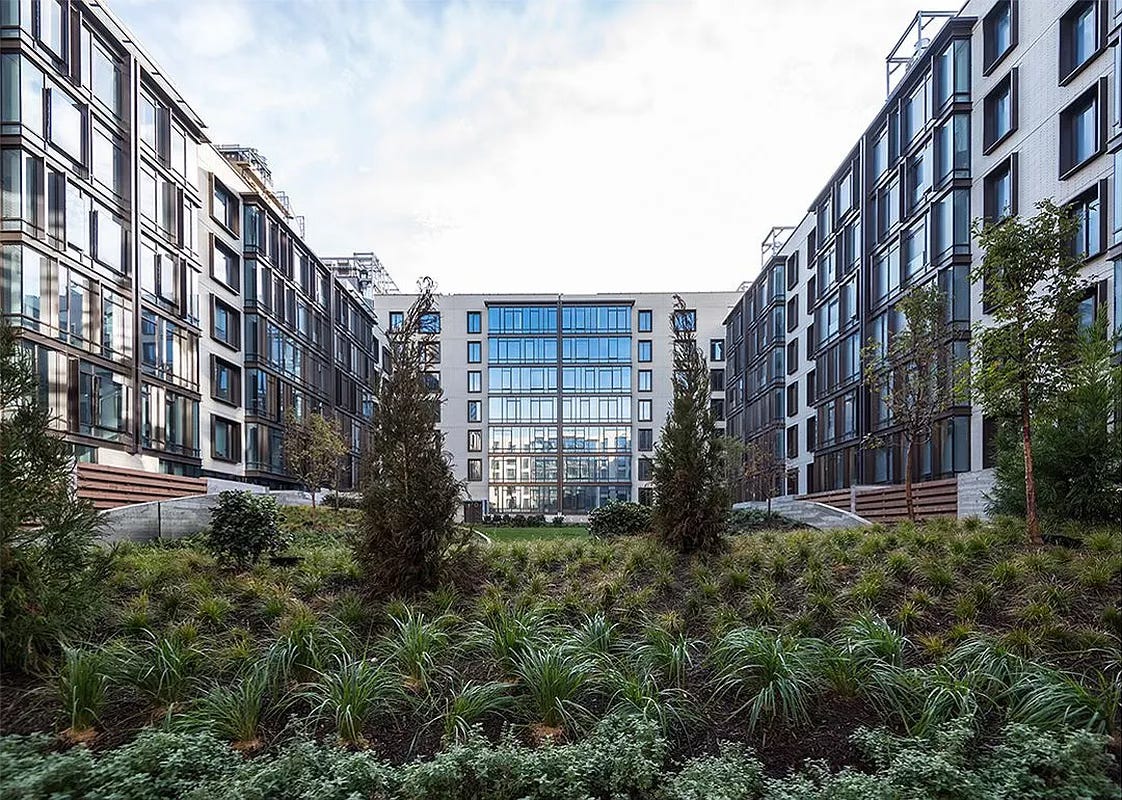
The courtyard itself is attractive, but its programming reflects a luxury development model and the reality that it sits above structured parking.
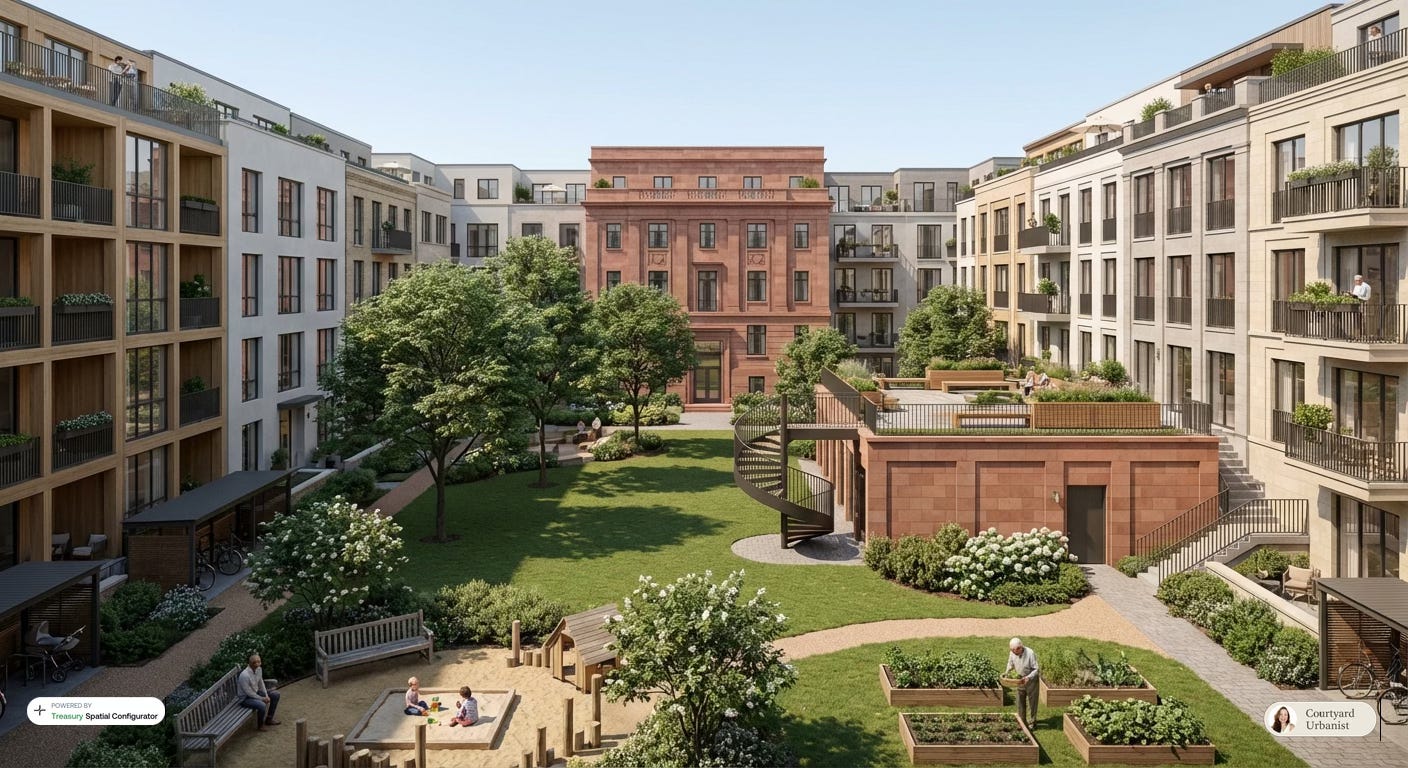
Traditional courtyard interiors are usually at ground level (deep, permeable surface) and function more like neighborhood backyards.
You typically see:
playgrounds
sandboxes
bike sheds
garden plots
mature trees
open space where children can play while adults watch from nearby windows


Play infrastructure, garden plots, and bike sheds are all signs that the courtyard is intended to be used by residents across the life cycle. Kids, bike commuters, gardeners.
Mature trees signal that there is not a $5M parking garage underneath the courtyard.
So, while the Oosten proves American developers can build courtyard blocks again, it does not yet demonstrate how to build them in the way that historically made them so socially and economically successful.
4. What This Means for American Courtyard Development
The Oosten is not a failure. In many ways, it is the most important modern American courtyard precedent we have.
But it also illustrates how contemporary development conditions can transform a flexible housing form into a monolithic luxury product.
Several structural factors push projects in that direction:
large development parcels
single-developer delivery
bundled luxury amenities
and, at the time the project was approved, significant parking requirements
When the Oosten was approved, Williamsburg zoning required parking for roughly 40% of units.
For a project of this scale, that effectively meant building an underground garage—one of the most expensive elements of New York construction.
Those costs flow directly into apartment prices.
Historic European courtyard blocks rarely carried that burden.
Most were built before widespread car ownership and had no structured parking at all.
Parking rules in New York have since changed, but the Oosten reflects the regulatory environment of its time.
The deeper issue, however, is development structure.
In cities like Prague, Copenhagen, and Berlin, courtyard blocks emerged incrementally:
multiple parcels
multiple developers
multiple buildings
That process naturally produced:
architectural variety
ownership diversity
a range of housing types
In modern American development, a single developer often builds the entire block at once.
When one entity carries all the risk on expensive urban land, the result is usually luxury housing.
How cities could make courtyard blocks work again
Cities that want real courtyard urbanism—not just luxury courtyard buildings—need to adjust the rules.
That includes:
subdividing large blocks into smaller parcels
reducing structural costs through tools like parking reform
permitting zero lot line buildings up to 6-8 stories
Courtyard blocks can work in the American regulatory environment.
The next step is recovering the incremental development model that historically made them architecturally diverse and widely attainable.
Final Grade: B+
If I had to give the Oosten a grade, it would be B+.
It proves that courtyard blocks are physically and financially viable in the American development environment.
Piet Boon’s design is serious, and the dual-aspect units are genuinely excellent.
What keeps it out of the A range is:
limited economic and architectural diversity
the absence of incremental development structure
the lack of family-compatible courtyard programming
For those of us trying to revive courtyard urbanism in the United States, the Oosten is an important precedent.
But it is still a luxury product serving one narrow slice of the market on one block in one very expensive city.
For courtyard urbanism to fulfill its potential—to keep families in cities and produce neighborhoods where people of different incomes and life stages can live together—we need a different development model.
We need:
many builders
many buildings
many price points
and many small acts of construction adding up to something coherent
The challenge now is figuring out how to build courtyard blocks the way they were historically built:
incrementally, by many builders, across many parcels.
To family-friendly courtyards in America,
Alicia Pederson
Courtyard Urbanist
Out of curiosity, how is the courtyard/maintenance thereof of a shared with courtyard legally handled in Europe? I suspect it's difficult to have a multiple different buildings, with different owners, sharing a courtyard in the US, unless there's some sort of HOA arrangement
One thing we learned from the New Urbanists and traditional neighborhood development is that when you're doing something new, different, and desirable it will become "luxury" even if it didn't start out that way. Case in point is Seaside FL, which started as a pretty ramshackle beach town with innovative/retro design principles and has become very expensive (because it's so nice!).
My suspicion is that the first ~20 years of a new courtyard housing movement will mainly be serving the upper 20% of income households, and we should manage expectations. (A small, 10-20, percent of the units are feasibly subsidized capital A affordable. But even if the first tranche of sales are "mid-market," if it is nice, then resales will quickly move to the top of the market.)