
Dear Friend, Subscriber, and Courtyard Urbanism Enthusiast,
In June, the policy landscape continued to shift directionally toward courtyard urbanism enablement. Single-stair reform is entering the mainstream. States and cities are beginning to reduce barriers to mid-rise, infill, and smaller-scale housing. Even Congress is starting to recognize point-access blocks, CDBG-funded housing construction, environmental-review reform, and manufactured housing as part of the national housing agenda.
These changes matter because courtyard urbanism will need legal reform to scale.
But June also showed how fragile reform can be. Modest proposals can stall. Broad housing packages can fail.
The encouraging news is that we do not have to wait for every statute, zoning code, or building code to change. In many places, courtyard blocks are already legal, nearly legal, or possible through existing entitlement paths. What is missing, in many cases, is simply leadership.
So, the opportunity right now is to find the places where land, rules, capital, and local will already align enough to begin.
Our next phase is not only policy reform, but proving through early projects that courtyard blocks are a buildable American housing model hiding in plain sight.
This month’s Market Brief covers:
CU Project Updates — Courtyard Urbanist is advancing a Boston-area courtyard block project, partnering with Bloomington-Normal on a downtown repair charrette, working with Chicago Growth Project to remove barriers to family-friendly housing, and fielding implementation conversations with developers, landowners, municipalities, capital partners, and civic groups across the country and beyond.
Our work with tech partner, Bucky Build, had yielded a courtyard feasibility tool (link below).
Single-stair reform — One less stairway can make a major difference for point-access buildings, family-sized apartments, shallow floorplates, and courtyard-block development.
Enacted state reforms — California’s SB 79 takes effect July 1, and New York passed major SEQRA reforms intended to make infill housing easier to build.
Local finance watch — Providence, Rhode Island’s BUILD Act shows how tax timing can make or break smaller housing projects.
Federal watch — The 21st Century ROAD to Housing Act passed Congress with overwhelming bipartisan support and includes provisions relevant to point-access blocks, CDBG funding, environmental review, and manufactured housing.
Losses and watch list — Connecticut’s “Golden Girls” room-rental bill stalled in the House, and Illinois’ BUILD Act failed to advance before adjournment, though some housing funding survived in the budget.

1. CU Project Updates
A lot is moving quickly behind the scenes.
First: a potentially history-making Boston-area project is advancing. I can’t share the project details publicly yet, but the pieces now coming together in an implementation pathway that Courtyard Urbanist was created to facilitate. We have land assembly, entitlements, public and private collaboration, CU design work, and now active conversations with potential GP partners.
If this continues to move forward, it could become one of the first major demonstrations of courtyard urbanism as a real development model for the American market. Hopefully, we will soon reach the point where I can share more specific details.

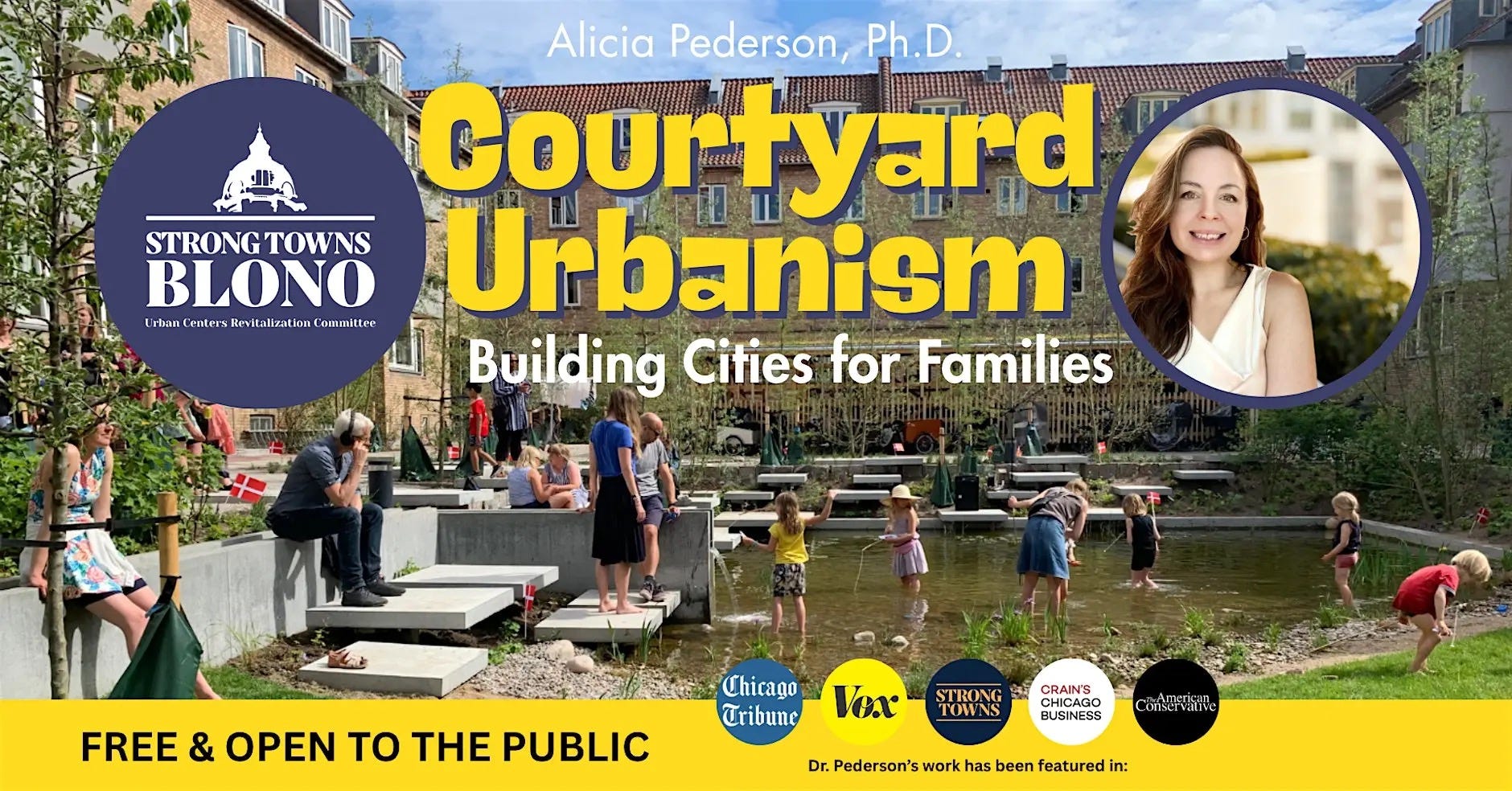
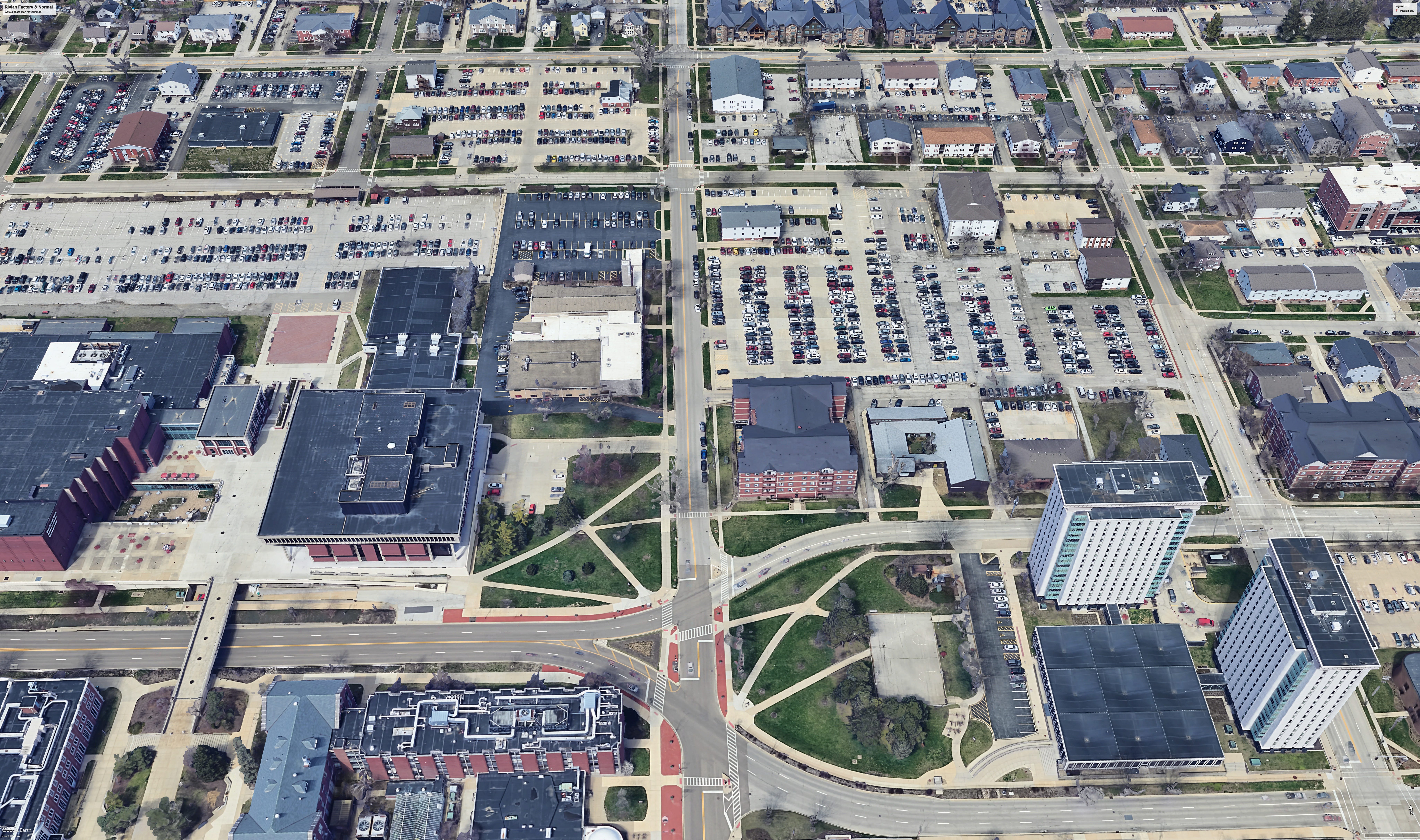
Second: Courtyard Urbanist is coming to Bloomington-Normal, Illinois. We are working with Strong Towns BLONO on the 2026 Downtown Charrette, beginning with public engagement and a keynote on courtyard urbanism, downtown repair, and building cities for families. Bloomington-Normal is one of the most interesting small-metro opportunities in the Midwest. It is a college town, a civic center, a major employment hub, home to Rivian manufacturing, and a place with real potential for fine-grained courtyard block growth.
Watch Bloomington-Normal for great courtyard block opportunities. Event details are here: Courtyard Urbanism: Building Cities for Families Charrette + Keynote.
Third: we are working with Chicago Growth Project on organizing a Chicago effort to remove the regulatory barriers to family-friendly housing. This includes the rules that make courtyard buildings, missing-middle housing, larger family-sized apartments, and fine-grained infill unnecessarily difficult or impossible to build: setbacks, height and density limits, and the structure of the ARO.
The first public event for this effort is Keep Families in the City: Building Neighborhoods for Lifelong Chicagoans, hosted by Chicago Growth Project on Saturday, August 16, 2026, from 1:00 to 3:30 PM at Le Village Lakeview. We’ll be talking about what reforms like courtyard buildings and missing middle housing can unlock for Chicago families, and how the city can make it easier for families to stay for the long haul. (Courtyard Urbanist)
Fourth: CU’s partnership with Bucky Build, a pre-construction technology platform for developers and AEC teams, has been productive in specific conversations, and more generally in developing tools that are broadly applicable to courtyard development.
Bucky turns the pre-construction planning maze into one guided workflow. For anyone taking a project from land to a real plan, construction isn’t the slow part but everything before it is: zoning feasibility, land constraints, design options, builder selection, permits, and financing, usually stitched together across five different consultants who don’t talk to each other. Bucky runs feasibility against local zoning, shows what’s actually buildable on a given parcel, and produces permit-ready planning outputs from day one.
One example close to home: on a recent Massachusetts courtyard project, Bucky cut through the as-of-right vs. conditional-use zoning question in a fraction of the usual research time. The kind of check that normally eats a week of back-and-forth before anyone can commit to a design direction. If you’re developing, or you advise people who are, reach out here
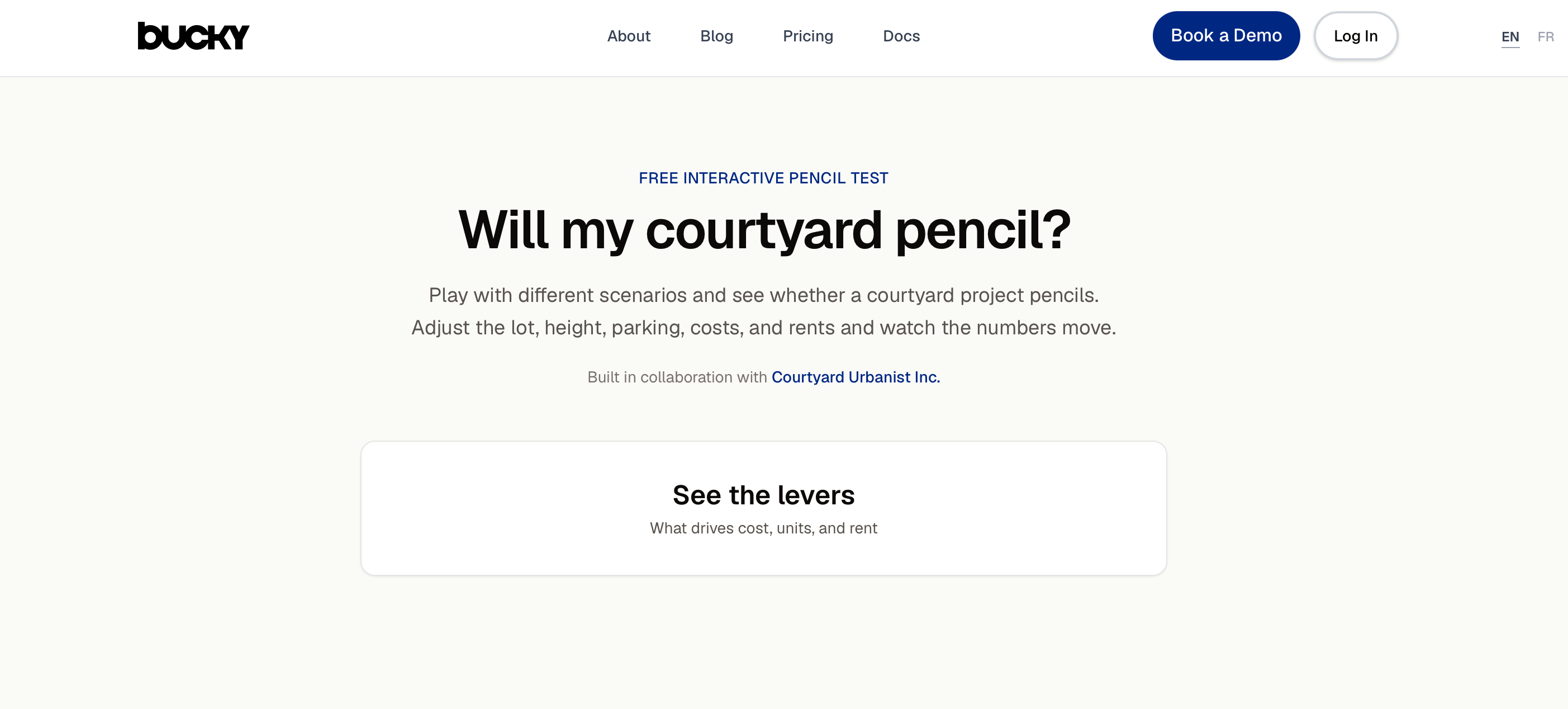
You can also check out the Courtyard Housing Feasibility Calculator they built for us. Will a courtyard housing project pencil? Test units, all-in cost, required rent, and developer margin in real time. Free feasibility calculator.
Finally, we are in multiple other conversations with developers, landowners, municipalities, capital partners, and civic groups across the country — and beyond. The implementation network is growing.
If you want to be an implementation partner, contact us at projects@courtyardurbanist.com.