


On Wednesday, Governor Pritzker stood before the Illinois General Assembly and proposed a sweeping overhaul of local zoning power to make it easier to build housing. Hurray!
The plan is called BUILD—Building Up Illinois Developments. It targets the local rules that have made it nearly impossible to build anything other than single-family homes in most Illinois neighborhoods. It would ban parking minimums on middle housing, legalize granny flats and backyard cottages statewide, modernize building codes, and put $250 million toward getting new housing off the ground.
Within hours of the speech, Representative Kam Buckner filed House Bill 5626—the actual bill that would turn BUILD into law. It’s over 40 pages long, and according to Elrod Friedman, a municipal law firm that tracks this kind of legislation closely, “...it’s the biggest challenge to local zoning authority in Illinois since the state established home rule power in 1970.”
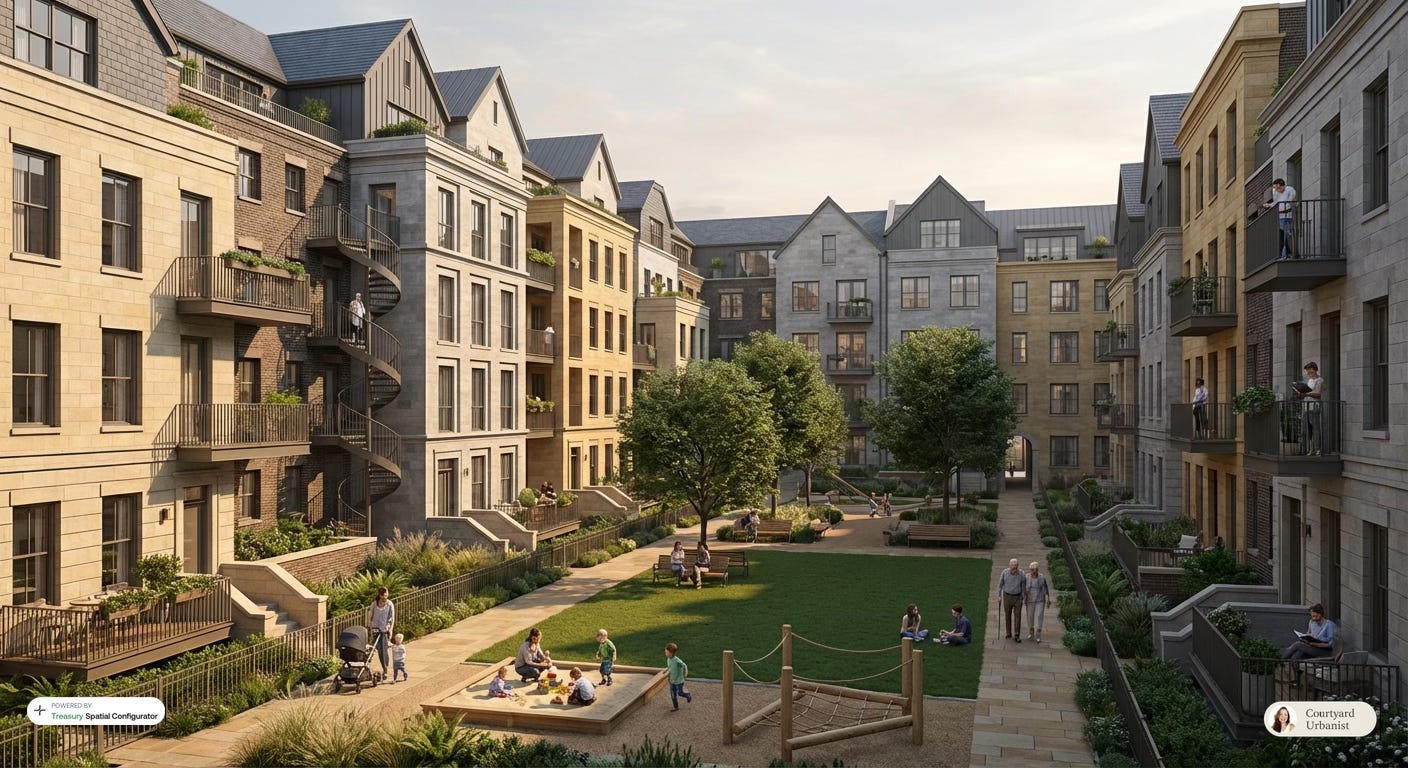
For those of us working to bring courtyard blocks to American cities, this is real progress. But it’s still only one brick in a larger barrier wall. Let us discuss what the bill accomplishes and where it falls short.
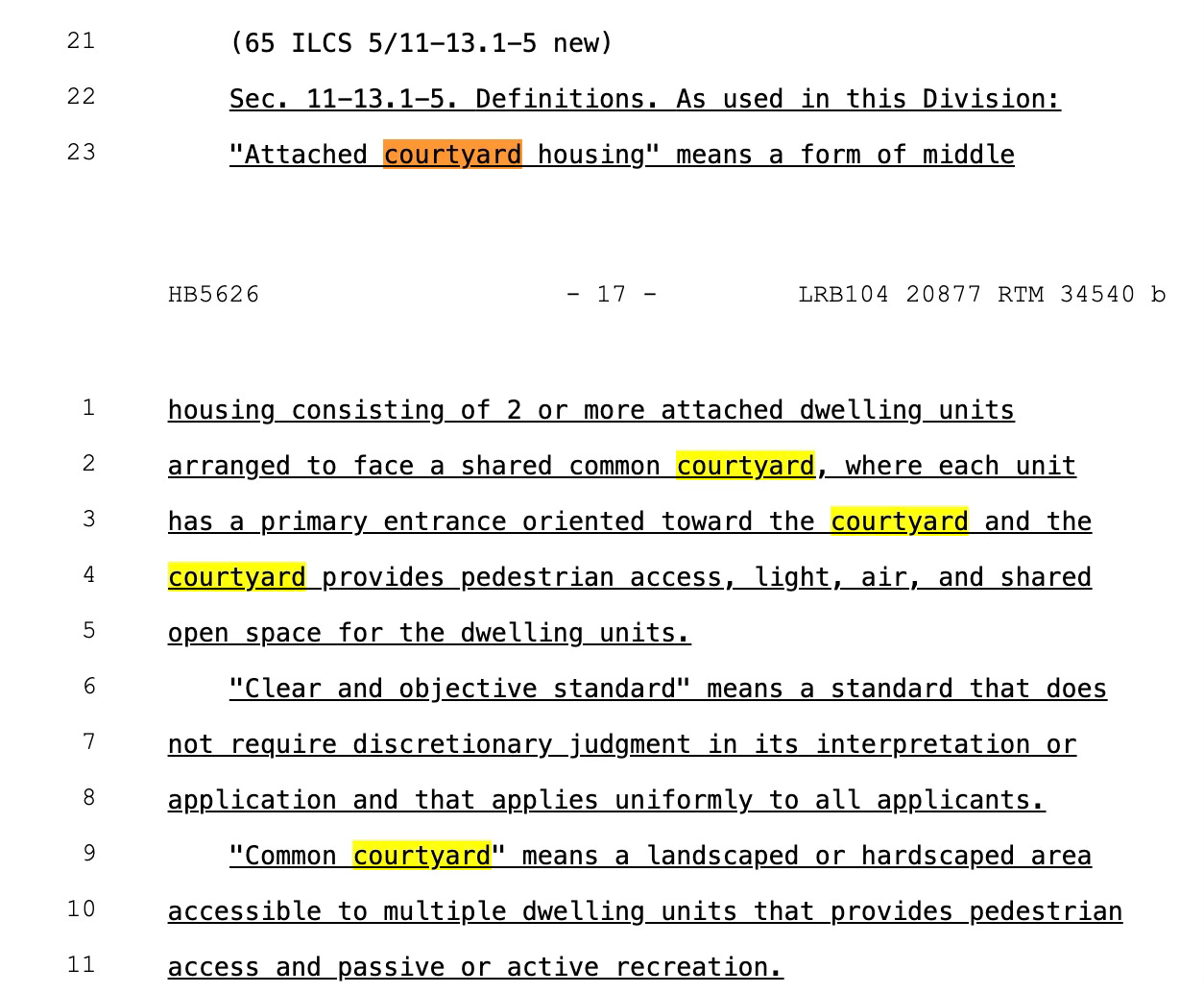
“Attached courtyard housing” is actually named in the bill, so that’s great!
HB 5626 creates a new legal category called “Middle Housing”—everything between a single-family home and a large apartment complex. Duplexes, triplexes, fourplexes, townhouses, cottage clusters, and “attached courtyard housing.”
That’s courtyard urbanism, written into Illinois state legislation by name!
Under the bill, local governments would have to allow Middle Housing anywhere single-family homes are currently allowed. No special permits. No review boards. No hearings where a handful of neighbors can kill a project. The bill uses a sliding scale—smaller lots can hold a few units, larger lots up to eight—but the main theme of the bill is very simple: if you can build a house on a lot, you should be able to build a small apartment building too.
This matters because courtyard blocks are made up of exactly these kinds of buildings—small, multi-unit structures lining a block perimeter. HB 5626 wouldn’t legalize a full 20-unit courtyard building on its own, but it would make the individual building blocks of courtyard neighborhoods much easier to get started.
Parking reform is in the bill, mercifully
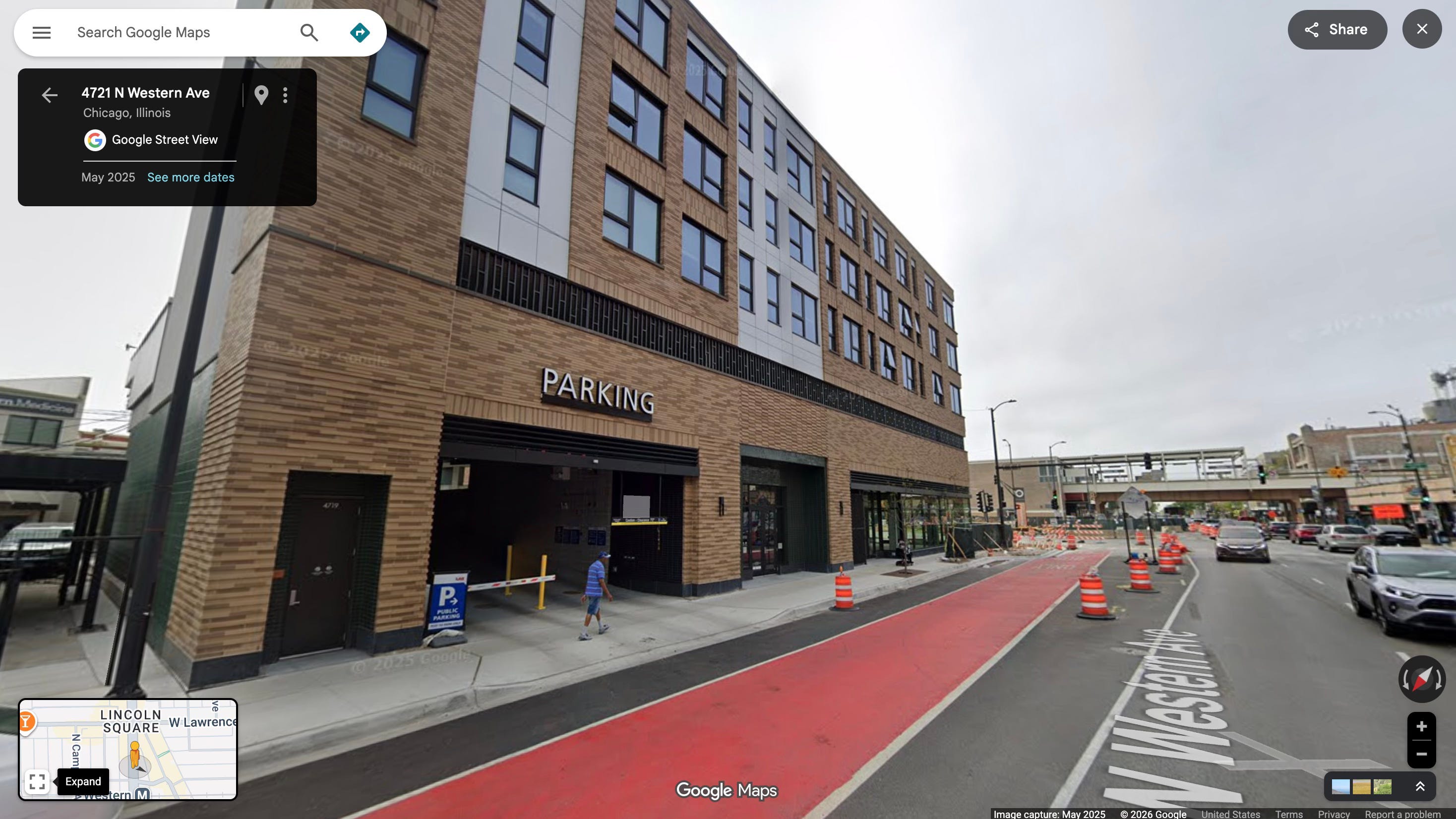
If you’ve ever wondered why new apartment buildings look the way they do (wrapped around a parking garage, set back from the street, no ground-floor shops) parking mandates are a big part of the answer.
When cities require one or two parking spaces per apartment, it eats up the land and money that could go toward housing, shops, or green space. A single structured parking space can add $30,000 to $60,000 to a unit’s cost. That’s not a typo. Parking requirements make our built environment ugly and expensive, and may be the main villain in the sad story of American urbanism.
HB 5626 would impose strict limits on how much parking local governments can require, and it would eliminate parking minimums entirely for small developments and buildings near transit. Chicago already took this step in 2025. This bill would extend it statewide.
$250 million for the invisible costs that sink small projects.
Before anyone builds anything, a site needs sewers, stormwater systems, utility hookups, and road access. Big developers absorb these costs across hundreds of units. A small developer building eight apartments on one lot (the kind of builder courtyard blocks need) often can’t afford it.
BUILD dedicates $250 million to site preparation grants, middle housing construction, and first-time homebuyer assistance. The site prep funding is modeled after an existing state program for industrial land. Applying the same idea to housing could unlock neighborhoods where courtyard development is currently too expensive to even start.
Three provisions in the bill that haven’t gotten enough attention.
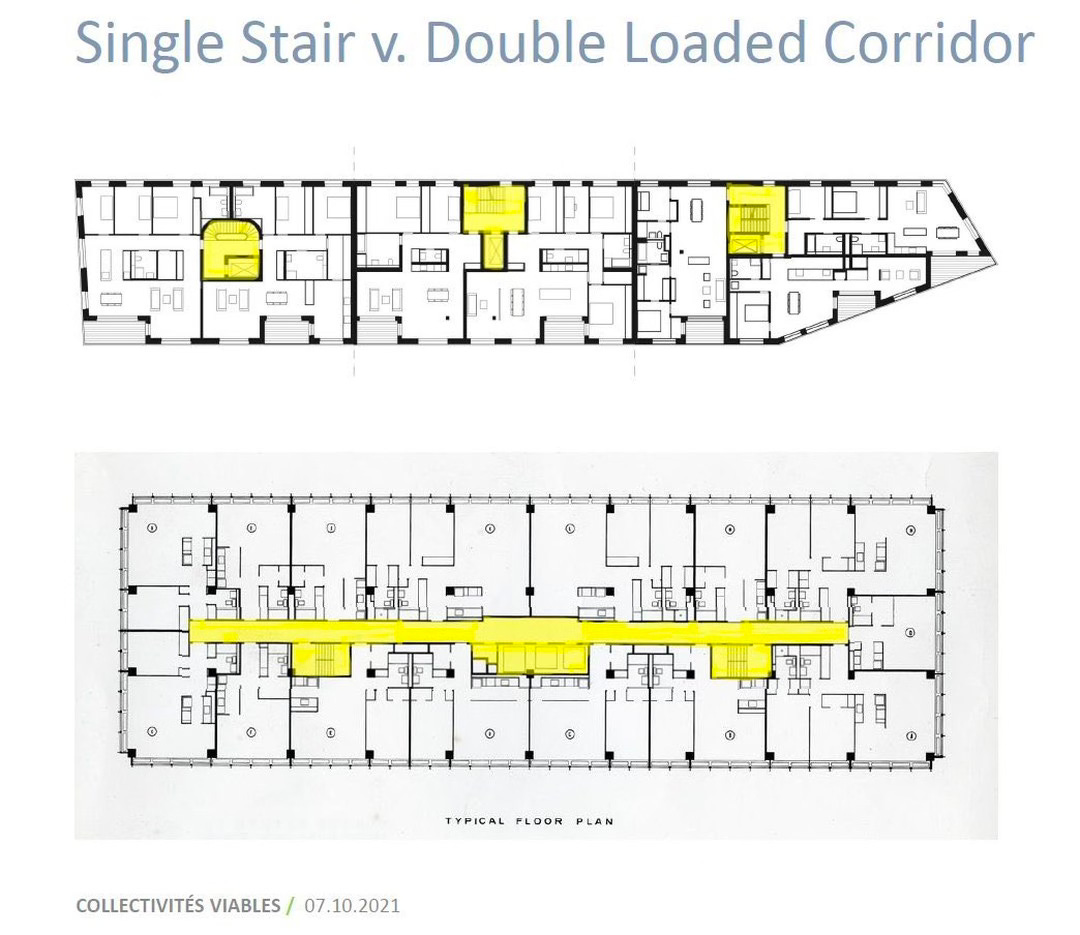
Single-stair construction. This is the one that surprised me. HB 5626 would let developers build multi-family buildings with a single stairway instead of the two staircases most U.S. codes require. Why does this matter? The two-staircase rule forces buildings to be wide and deep—exactly the opposite of the narrow, shallow buildings that create courtyard blocks. Nineteen states are already moving on single-stair reform. If this bill passes, Illinois joins them.
Hard deadlines on plan review. The bill gives local governments strict timelines for reviewing plans and inspecting buildings. Miss the deadline? The applicant can hire a private inspector, and the municipality has to accept the results. This targets one of the quietest ways local governments kill projects: by simply not processing them.
Standardized fees. Right now, the fees local governments charge developers vary wildly from town to town. HB 5626 would require uniform formulas statewide, so the cost of building the same project doesn’t double just because you crossed a municipal border.
And one overarching rule worth knowing: every provision in the bill says local governments can be more permissive than the state standards, but not more restrictive.
The opposition has difficult position of defending deceleration and decline
The Illinois Municipal League warned against state involvement in zoning, and House Republicans called it overreach. That was predictable. It’s the same response seen in Colorado, Washington, and California.
But this is ultimately an argument for deceleration and decline. It asks Illinois to accept fewer homes, fewer families, and less growth. This is an approach unlikely to find support in a state where there is broad demand for policies that expand housing and opportunity.
Illinois is short roughly 142,000 homes. That shortage is already driving up costs and pushing families out. If HB 5626 passes, it takes effect January 1, 2027, with eight months for local governments to comply before state standards apply.
What’s still missing: elevator codes!
The single-stair provision was a welcome surprise. But there’s one major barrier left that HB 5626 doesn’t touch: elevator rules.
Federal law currently requires elevators in multifamily buildings to be large enough to fit a stretcher—which makes them so expensive that many small builders skip the elevator entirely. The result: upper floors in small buildings are inaccessible. That’s a problem for families with strollers, older residents, and anyone with a disability.
Washington State is leading the way with a bill that would allow smaller, wheelchair-accessible elevators in buildings of six stories or fewer. And a bipartisan group in Congress is pushing to reform the federal standards so states can adopt this kind of common-sense fix without violating the Fair Housing Act.
Without elevator reform, HB 5626 gets us further than I expected—zoning, parking, single-stair, inspection timelines—but we still can’t build the fully accessible courtyard buildings we need at a price point small developers can handle.
What comes next
BUILD is the proposal. HB 5626 is the bill. The spring legislative session will determine whether it survives, gets watered down, or stalls. I’ll be tracking it closely and writing about what it means for courtyard development as the details take shape.
Between HB 5626, single-stair reform spreading across the country, and the federal elevator push, this is one of the more promising stretches for courtyard urbanism that I’ve seen since I started this work. The policy conversation is finally catching up to the design conversation—and that’s worth paying attention to.
→ Want to go deeper with me? I’ll be releasing the Courtyard Urbanist Monthly Market Brief soon, covering who’s actually moving on courtyard projects, where policy windows like BUILD are opening, and what our Advisory Council and investor partners are working on behind the scenes. Paid subscribers get this exclusive report every month.
You’ll also get access to Quarterly Insider Roundtables—live video calls where you get behind-the-scenes looks at active courtyard projects, workshop design questions in real time, and connect directly with the developers, planners, and architects building this movement. Think of it as your seat at the table.
If BUILD or this bill raises questions for you—about your city, your project, or what courtyard development could look like where you live—leave a reply. I’d love to hear from you.
To family-friendly courtyards in America!
See you then,
Alicia Pederson
Courtyard Urbanist
I'm excited we get to reap the benefits of Pritzker's presidential ambitions. The BUILD Act is such a swing for the fences, something that our regular state government wouldn't try to adopt all at once a couple years ago.
I'm more impressed that this gets into building codes like single stair, because Abundant Housing IL, the YIMBY affiliate here said that bill was at least a couple years away from being viable. It's now time to rally in support, ensure that these don't get watered down, maybe introduce our state reps to that report on changing elevator codes, and lobby lobby lobby until this bill crosses his desk.
Once this is done, the hard work of actually developing courtyard blocks and other good urbanism will commence.
Such an exciting development!