


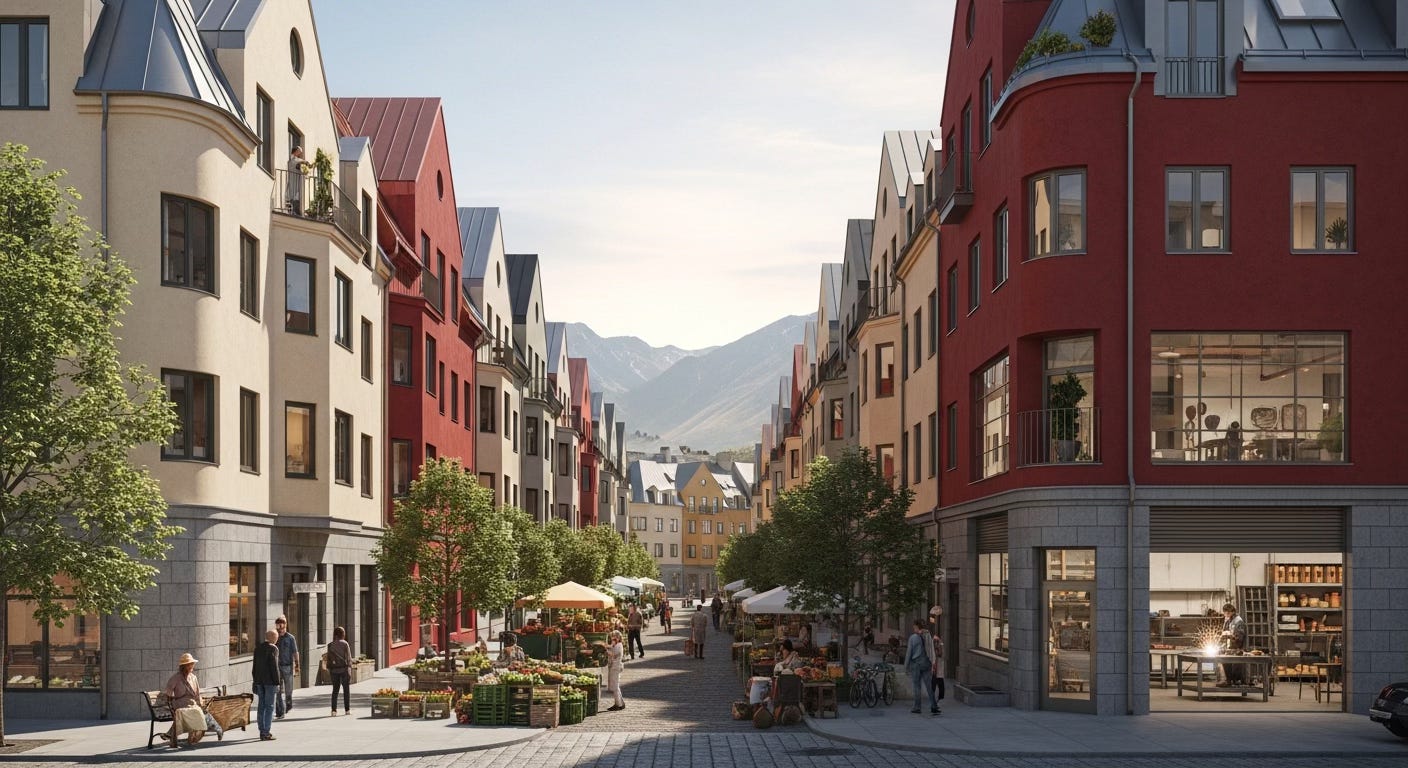
Courtyard Urbanism Is Moving From Theory to Projects
A few weeks ago, a developer in the Mountain West reached out about courtyard blocks.
They are overseeing a massive 1,000-acre master-planned community—a project expected to deliver roughly 3,000 homes adjacent to a major new advanced manufacturing and aerospace hub.
They had been following the conversation about courtyard urbanism online and wanted to talk about what courtyard blocks could look like in this context.
We spent an hour talking through the vision and implementation. We discussed how courtyard-oriented buildings could organize the residential “fabric” of the development, providing a sense of enclosure and community that standard suburban pods lack.


We looked at how these streets and courtyards could structure the neighborhood’s identity and—most importantly—what the development math looks like.
Courtyard housing is “missing middle” par excellence. At four to six stories, these buildings deliver meaningful density while avoiding the “high-rise tax”—structured parking, massive concrete systems, and complex elevator cores. In a rapidly growing tech and manufacturing corridor, they offer a family-friendly, financially feasible alternative to both sprawling subdivisions and anonymous podium apartments.
It was a great exploratory conversation that signals a shift: Developers are moving from “Why?” to “How?”
Minnesota, Twice


A few weeks later, two separate conversations opened up in Minnesota.
The first was with Carlton County, a rural community facing a challenge familiar to many Midwestern towns:
• Population decline
• Falling school enrollment
• Young families moving away
The county is exploring a federal planning grant and asked whether Courtyard Urbanist could serve as a technical partner—helping model housing scenarios that could attract and retain families.
One idea under discussion is testing redevelopment options around the Carlton Schools site using the Courtyard Urbanist platform.
What would it take to transform underutilized land into housing that actually works for families with kids?
The broader question is simple:
What if small Midwestern towns could build courtyard housing that fits their scale and character?
Around the same time, a second conversation began with Brooklyn Center, a suburb of Minneapolis.
The city is planning a major redevelopment initiative called Civic Square, and local officials are exploring whether courtyard block planning could help shape a walkable, family-friendly district as part of the larger master plan.
In early March, I met with Brooklyn Center’s Economic Development Manager and the architectural team working on the project.
The city has begun sharing technical materials—site maps, infrastructure considerations, early phase layouts—and we’ve shared our advisory framework for how courtyard planning could fit into the process.
Both conversations are still early! But they signal strong interest in courtyard urbanism, which is emerging across very different contexts—from rural counties to suburban redevelopment districts.
Regenerative Urbanism in the Pacific Northwest
Most recently, the conversation has moved west.
I am currently in talks with a developer in Salem, Oregon, regarding a vision for a new Innovation District.
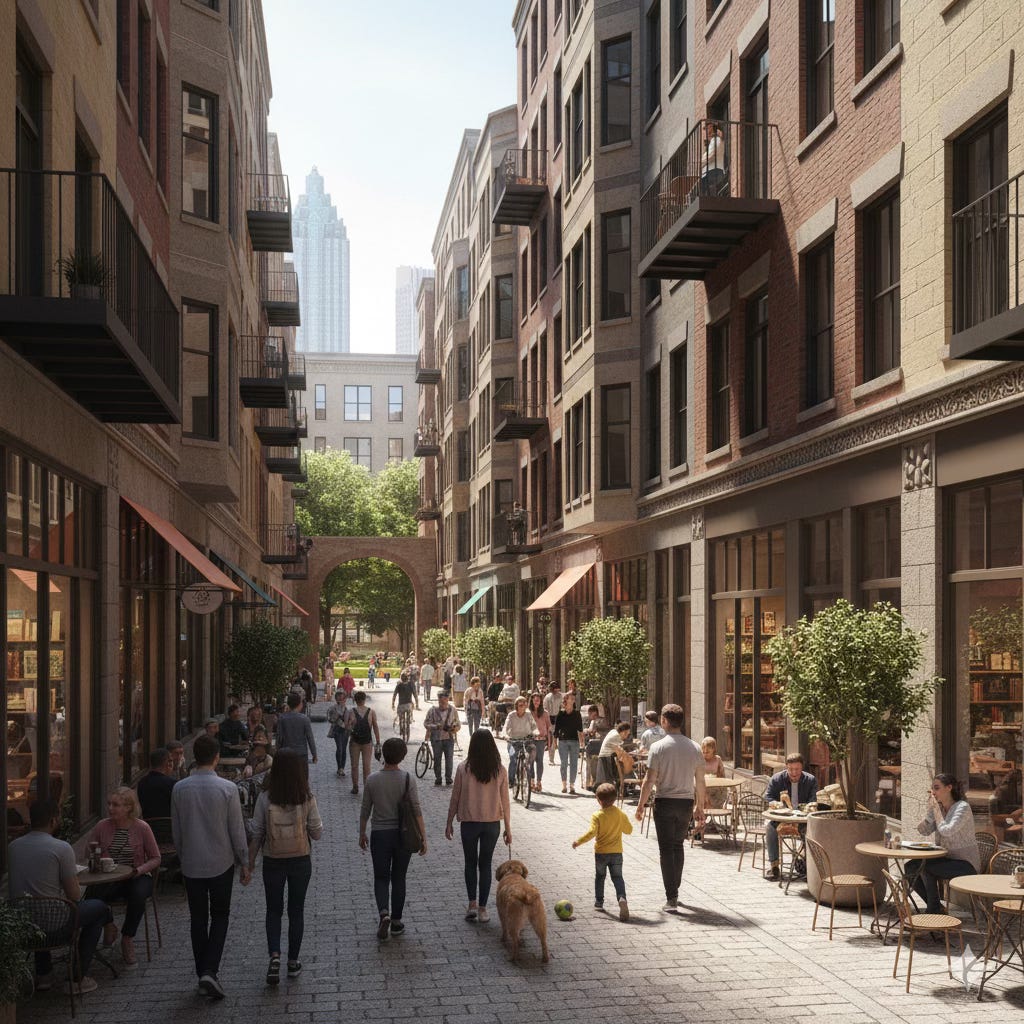
This project isn’t just about adding housing. It’s about what the planners describe as “Neighborhoods as Living Systems”—walkable, nature-connected districts that transform underutilized industrial land.
The site is a strong candidate for a courtyard block pilot.
Because the district goals emphasize human-scale interaction and the power of proximity, courtyard prototypes offer a way to achieve urban density while preserving the private green sanctuaries that families crave.
We are currently exploring how the Courtyard Urbanist design catalogue could provide the residential DNA for this regenerative master plan.
The Pacific Northwest already has a long tradition of innovative wood-frame construction and missing-middle experimentation, which makes Salem a particularly promising place to test whether courtyard urbanism can be both ecologically restorative and financially viable.
The Design Work


Meanwhile, architect David Getzin and I have been building something I’ve wanted to create for a long time.
David is an architect in Pasadena and a longtime collaborator. Thanks to early support from our Founding Investors, we’ve begun translating my archive of courtyard buildings, floor plans, and block structures into something more systematic:
A flexible catalogue of adaptable building and block prototypes.
In many ways, the inspiration comes from Christopher Alexander’s A Pattern Language.
Alexander argued that great places are rarely invented from scratch. Instead, they emerge from recurring spatial patterns—relationships between buildings, streets, courtyards, and rooms that people have refined over centuries.
Courtyard urbanism is full of these patterns.
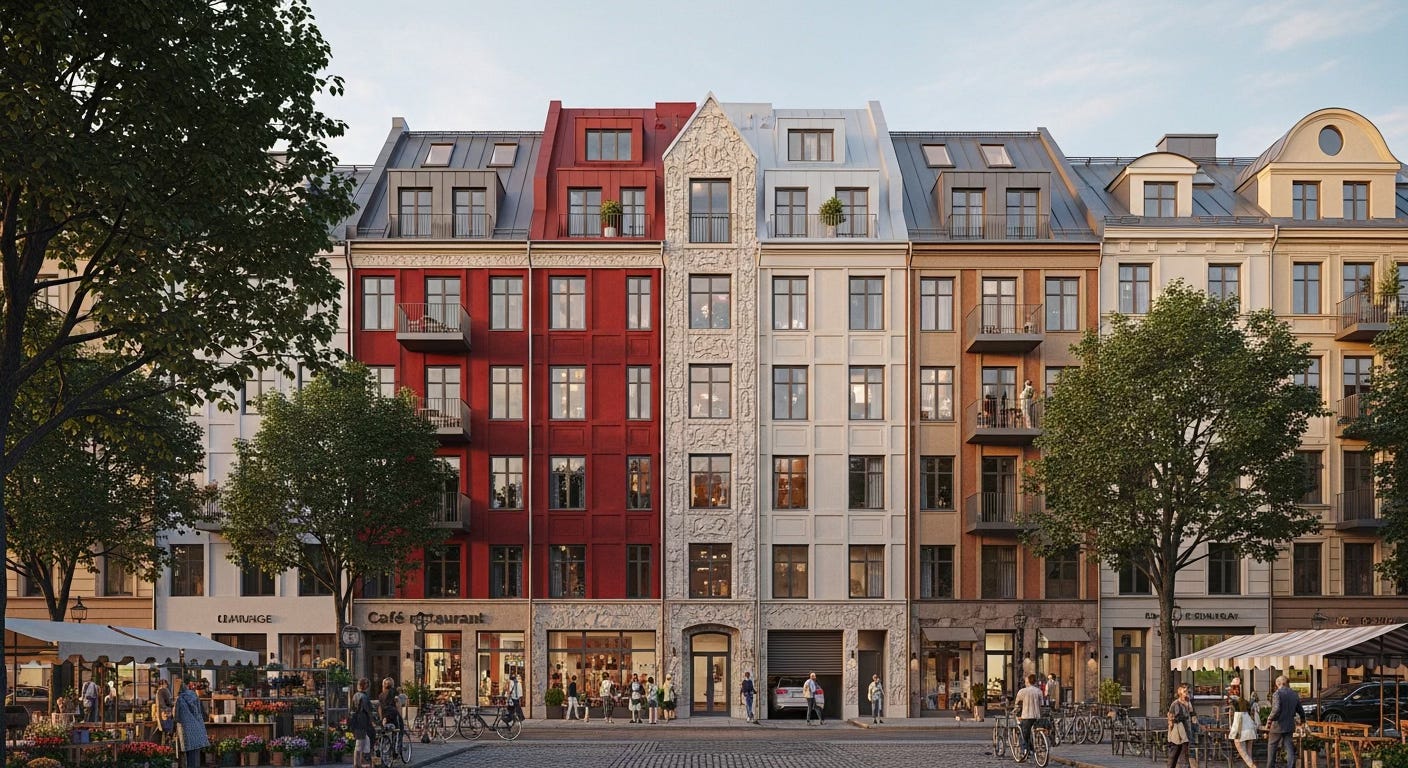
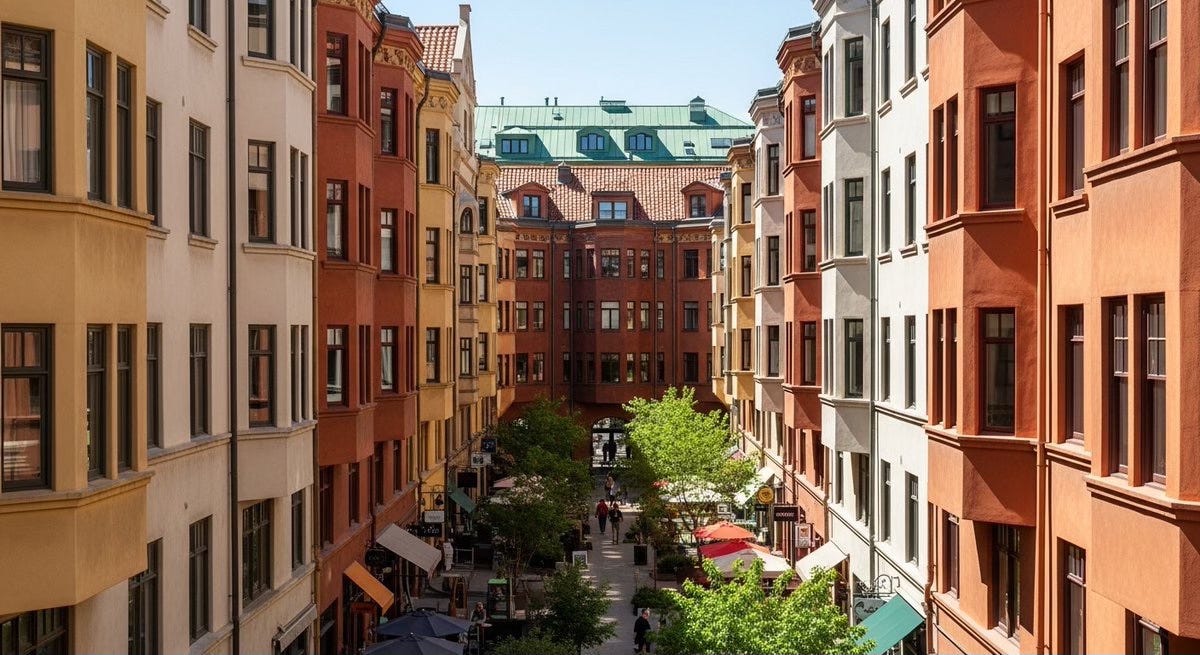
Across many European cities and historic neighborhoods, courtyard blocks consistently share spatial structures such as:
• Corners that anchor blocks
• Buildings arranged around shared gardens
• Entrances that transition between public streets and private homes
• Wings that extend into courtyards to increase density while preserving light
These patterns appear again and again because they work. They allow parents to do things like say, “Go play outside!” to young children.
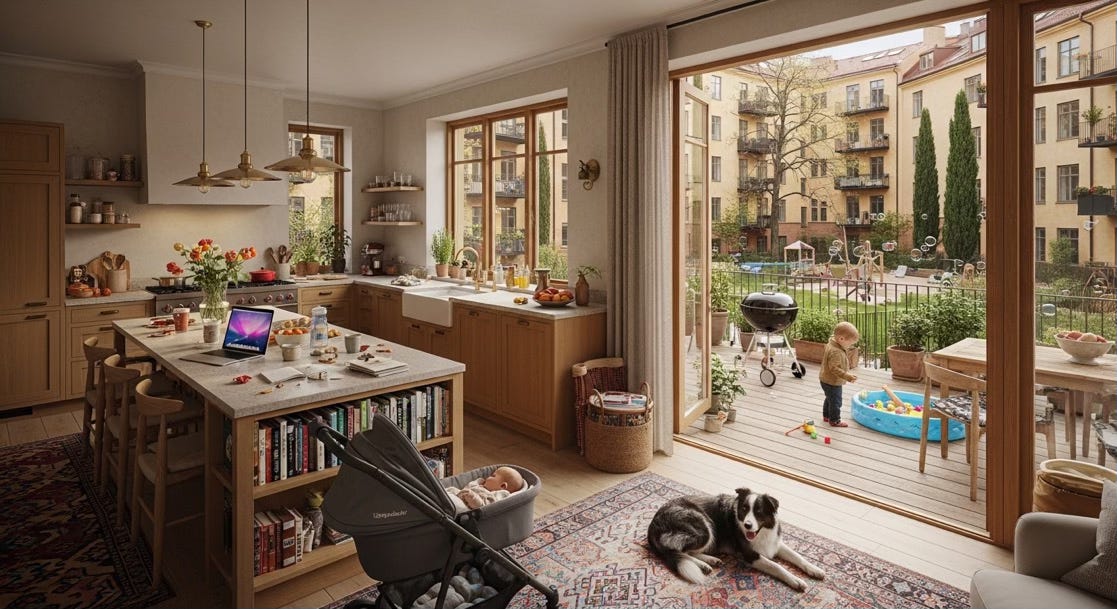
What David and I are doing is translating those patterns into a contemporary design system.
Instead of designing one-off buildings for individual sites, we are developing a family of courtyard building types that can be configured for many different contexts.
The designs are being built in parametric form, allowing them to be adjusted quickly—testing densities, site layouts, and housing programs without starting from scratch.
In a sense, the project is a technological continuation of Alexander’s insight:
A pattern language for courtyard housing that can be applied to real development sites.
The goal is simple:
A working catalogue of courtyard buildings and blocks—based on proven urban patterns—that can be adapted to sites across many different cities.
The Tools and the Team
Alongside the design catalogue, the Courtyard Urbanist platform continues to evolve.
It allows us to drop courtyard buildings onto real parcels and instantly see how they affect density, layout, and site organization.
But good housing is not just about software.
It’s about people who have actually built cities.
To that end, I’ve begun formalizing a Courtyard Urbanist Advisory Council.
Rather than a static list of names, this will function as an active working group, helping peer-review our first three Block Templates to ensure they meet rigorous aesthetic, financial, and code-compliance standards.
Our collaborators include:
• Virginia Postrel — Author & Columnist
• Chuck Marohn — Strong Towns
• Nicholas Boys-Smith — Create Streets
• Shajay Bhooshan — Zaha Hadid Architects
• Lindsay Sturman — Livable Cities Initiative
• Kasey Klimes — Rhizome R&D
• Gabe Metcalf — California Forever
• Stephen Smith — Center for Building in North America
• Matt Hutchins — CAST Architecture
• Michael Lane — SPUR
• Laura Fingal-Surma — Urbanist Ventures
Out in the world
The conversation around courtyard urbanism continues to spread.
Last month, I joined the Hogtown podcast with Toronto developers Matt and Chris Spoke. We talked about missing-middle housing, block structure, and the challenge of delivering beautiful, family-friendly density in North American cities.
You can watch it here:
Courtyard urbanism is also popping up in unexpected places.
A recent Edinburgh Substack column argued for reviving fully enclosed courtyard blocks as a way to deliver beautiful density while maintaining strong street structure. The piece analyzes Marchmont’s historic courtyard blocks and makes the case that Edinburgh should be building more of them today.
Read it here:

What this means
For the past year, Courtyard Urbanist has mostly been advocacy—writing, speaking, and explaining.
But the pieces are clicking into place:
The platform (Rapid site testing)
The advisory council (Expert peer review)
The design catalogue (Buildable architecture)
The pilot leads (Real-world implementation)
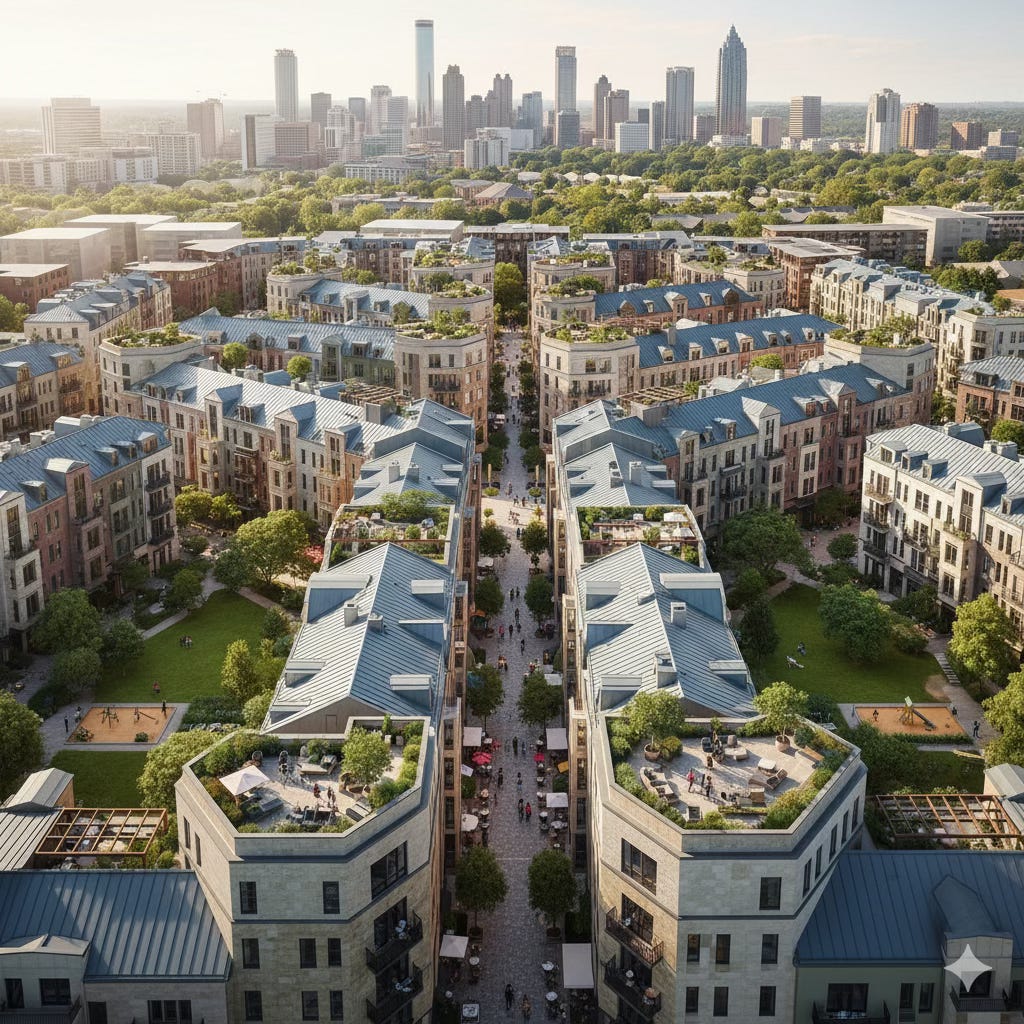
We are building the infrastructure to move from essays to projects.
Pilot projects
One of the goals of Courtyard Urbanist this year is to collaborate on a small number of pilot courtyard block projects.
We’re especially interested in working with:
Developers exploring courtyard housing on sites between 1 and 5 acres.
Cities looking for family-friendly urban housing prototypes.
Builders or modular manufacturers interested in repeatable courtyard systems.
If you’re working on a site where courtyard housing might make sense, I’d love to hear about it.
Please contact us here: projects@courtyardurbanist.com
To family-friendly American cities.
See you then,
Alicia Pederson
Courtyard Urbanist
PS - For our paying subscribers and founding members, we’ve just released our first Marketing Brief!
In it, I share a deep dive into:
Key Policy Wins & Losses
Projects in the Pipeline
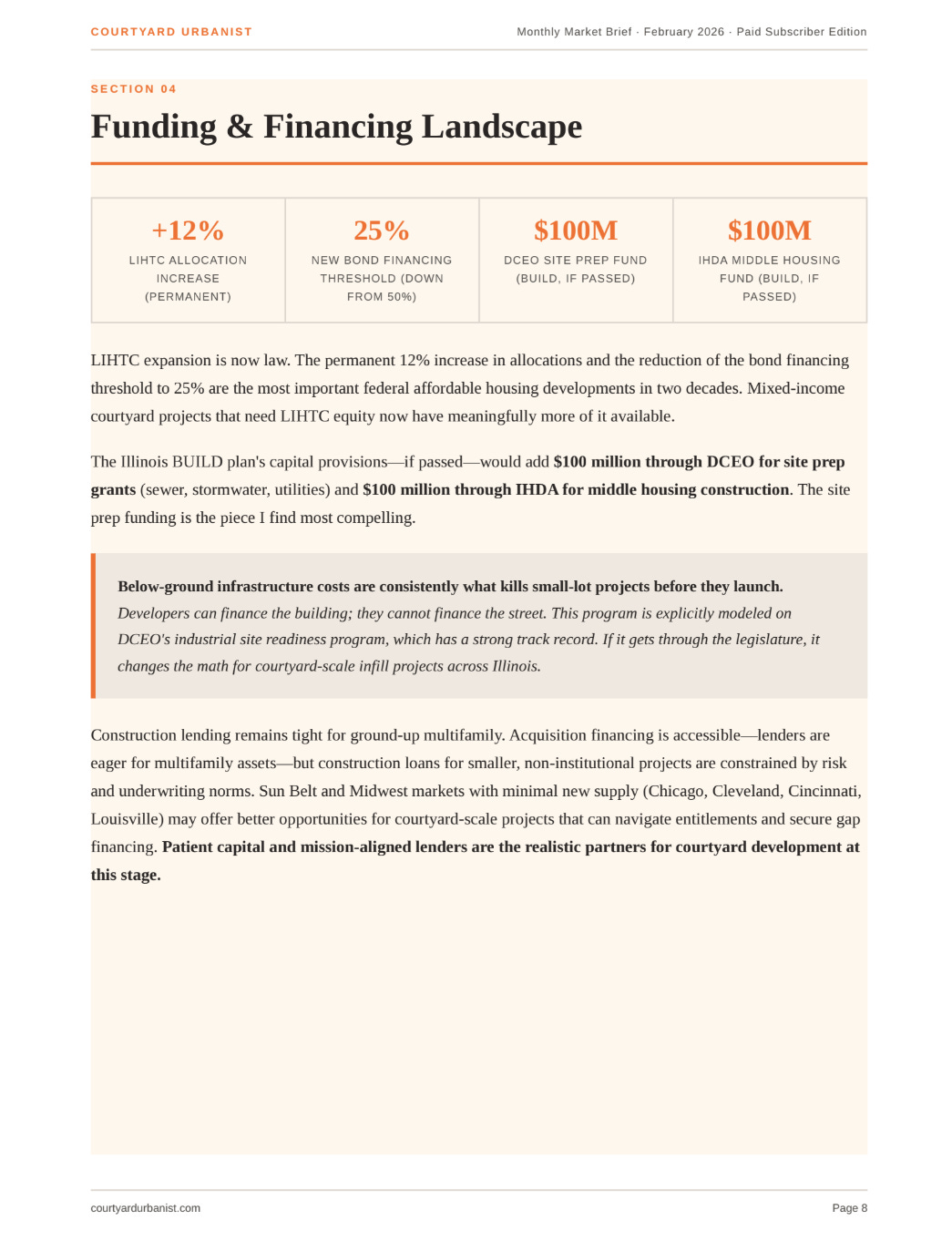
Funding & Financing Landscape
Opportunity Alerts
What I’m Reading & Thinking About
And more!
Here’s a sneak peek:
Want access to February’s Marketing Brief (and more in-depth briefs every month?)
Throughly researched, delightful to read. I wondered if you had any other book recommendations? :)
I am a paid subscriber since 1/13/26 I think. How can I read the February marketing brief?